

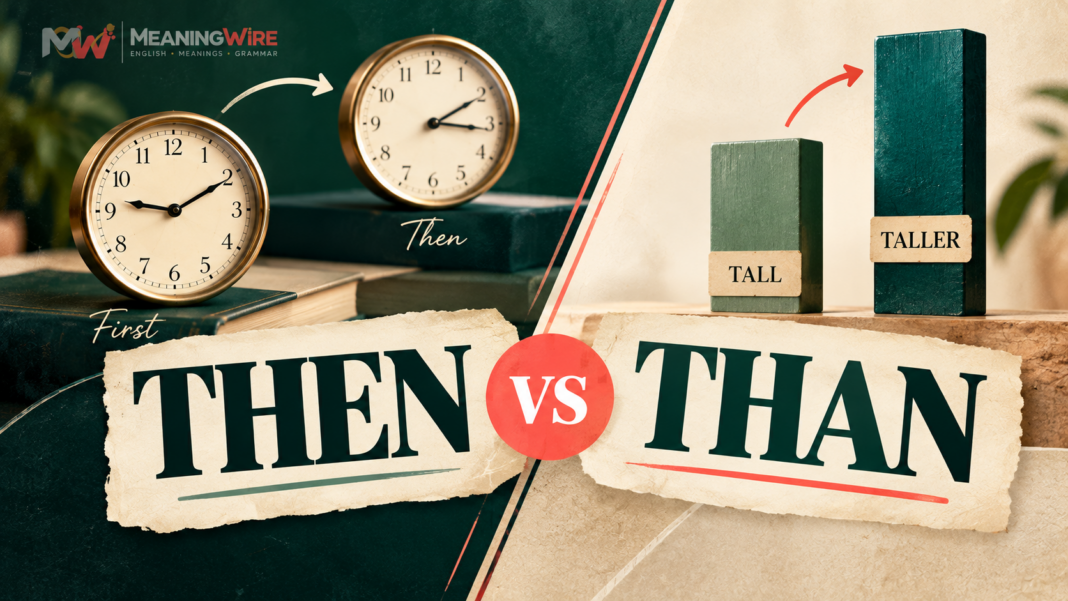
“Finish your homework, than watch TV” looks almost right, but one letter changes the meaning. The correct word is then, because watching TV happens after homework. Compare it with “I’d rather watch TV than do homework.” This time than is correct because the speaker compares two choices.
Then usually refers to time, sequence, or a result. Than connects things in a comparison. Both are real English words, and neither is a universal replacement for the other. If you know what the sentence is trying to do, you can usually pick the right one without memorizing complicated grammar terminology.
Two Letters, Two Different Jobs
Then: What Happens Next?
Use it for a time, the next step, or a consequence.
Eat dinner, then wash the dishes.
Than: How Do They Compare?
Use it to compare people, objects, quantities, or choices.
This route is shorter than that one.
A useful first check is to ask whether you mean next or compared with. “Next” points toward then. “Compared with” points toward than. That test does not cover every expression, but it solves most everyday cases.
Then Is About More Than the Clock
You probably learned then as a word about time. That’s a strong starting point. It describes a particular moment in the past or future, or tells a reader what comes next. Yet it also appears when one action leads to another or someone draws a conclusion.
Back then, our neighborhood had only one grocery store. Here, then points to a period in the past. “We will know more by then” refers to a future point. Neither sentence compares anything.
Giving Instructions in Order
Recipes, directions, classroom instructions, and work messages use then to show sequence. “Turn off the computer, then unplug the cable” tells the reader to complete one action before the next. “First check the address. Then send the invitation” does the same thing.
Look at what happens if you change the spelling: “Turn off the computer, than unplug the cable.” That sentence now tries to use a comparison word where the reader expects the next step. It no longer works.
When a Condition Leads to a Result
An if … then sentence connects a condition with its result. “If the meeting ends early, then we can get lunch.” Another example is “If the password is wrong, then the website will reject the login.” In these sentences, then means something close to in that case.
You can often omit then without changing the basic meaning: “If it rains, we’ll stay inside.” Keeping it can make the connection explicit, especially in instructions or logic. The Cambridge Dictionary grammar entry describes these uses as time, sequence, addition, and result.
Than Belongs in a Comparison
Suppose you’re deciding between two hotels. One costs $120 a night and another costs $160. You could write “The first hotel is cheaper than the second.” The word than creates the connection between what you’re comparing.
It works with more than prices. People compare height, speed, age, distances, moods, difficulty, and preferences. “This test was harder than yesterday’s.” “I’d rather walk than drive.” “Her answer was clearer than mine.” Every example weighs one thing against another.
Words such as better, worse, more, less, older, younger, and rather often signal that than will follow. They aren’t an absolute guarantee, but they make a useful clue.
Comparing Numbers and Amounts
In “We need fewer than 20 chairs,” than introduces the number used as a limit. “The package weighs more than five pounds” compares the weight with five pounds. “Less than an hour” is also a comparison, even though only one quantity appears explicitly. The implied comparison is with that threshold.
This matters in real instructions. An email that promises delivery in “less then two days” contains a spelling mistake. “Less than two days” correctly expresses a limit on time; it does not mean “after two days.”
The Difference Shows Up in These Messages
Incorrect: Let’s eat, than head out.
Correct: Let’s eat, then head out.
Reason: The second action comes next.
Incorrect: This jacket is warmer then mine.
Correct: This jacket is warmer than mine.
Reason: Two jackets are being compared.
Incorrect: If that’s true, than we need to leave.
Correct: If that’s true, then we need to leave.
Reason: The second clause describes the result of the condition.
Spelling software might flag these errors, but context is still the best check. Both words exist, so an automatic tool cannot always know which meaning you intended. Read the entire sentence instead of examining only the word.
“Better Than” and “Rather Than”
Two everyday phrases cause a surprising number of mistakes. Better than is a comparison. “This version is better than the last one” evaluates two versions. Rather than introduces an alternative. “Rather than order delivery, we cooked at home” compares two possible actions and identifies the one chosen.
Don’t write better then or rather then when the intended meaning is comparison. There can be unusual contexts where better is followed by a new clause with then, but that is not the standard comparative phrase.
A particularly useful distinction appears in “I’d rather leave now than wait until then.” The first word, than, contrasts two choices. The second, then, refers to a later time. Both belong in the sentence. Merriam-Webster’s usage discussion confirms the comparison and time distinction and notes common constructions such as other than and rather than.
Expressions That Don’t Fit the Simple Trick
English has a few set phrases worth learning on their own. Other than often means except for: “Other than the weather, the trip was perfect.” It isn’t a straightforward comparison of size or quality, but the standard spelling remains than.
No sooner … than describes two events occurring close together: “No sooner had we sat down than the lights went out.” Even though the sentence describes timing, the established expression uses than, not then. This is one reason the quick next-versus-comparison test is helpful but not infallible.
On the other side, now and then means occasionally. Back then refers to an earlier time. Until then refers to a future point or period. These standard phrases all use then.
A Punctuation Detail Worth Knowing
People sometimes write “We finished dinner, then watched a movie.” The comma helps separate two connected actions in one sentence. In “We finished dinner, and then we watched a movie,” the conjunction makes the connection even clearer. Both are common patterns.
If you’re combining two full independent sentences, use appropriate punctuation. “We finished dinner, then we watched a movie” can be treated as a comma splice in formal writing. “We finished dinner. Then we watched a movie” or “We finished dinner, and then we watched a movie” removes that concern.
Don’t assume then always needs a comma. “Then I realized the door was open” is a complete sentence without one. Punctuation depends on sentence structure and emphasis, not merely on which of these two words you choose.
Try Reading These Like an Editor
Choose the missing word by asking what the sentence does. Is it ordering events, drawing a consequence, or setting two things against one another?
- Send the email, and ___ call the office.
- She’s more experienced ___ I expected.
- If you’re free, ___ we can meet after lunch.
- I’d prefer tea ___ coffee.
- We haven’t spoken since ___.
- The repair cost less ___ the estimate.
Check the answers and reasons
1. then, because the call follows the email. 2. than, because the sentence compares experience with an expectation. 3. then, because it introduces a result. 4. than, because two choices are contrasted. 5. then, because the word refers to a past moment. 6. than, because the price is compared with an estimate.
Consider this slightly harder sentence: “I’d rather finish the report today than rush tomorrow, because then we’ll have time to review it.” The than compares two approaches. The then refers to the time or resulting situation after the report is finished. You don’t need an elaborate rule to understand it once you notice each word’s role.
One Last Editing Habit
Read a sentence with then or than and identify its purpose before checking spelling. If it gives the next step, points to a moment, or expresses a consequence, then is usually right. If it measures a difference or names an alternative, than is usually right.
This approach also helps with other look-alike words. Our your vs. you’re guide deals with possession and contractions, while the its vs. it’s guide offers another quick check for everyday writing. In each case, meaning is the most reliable spelling clue.
