

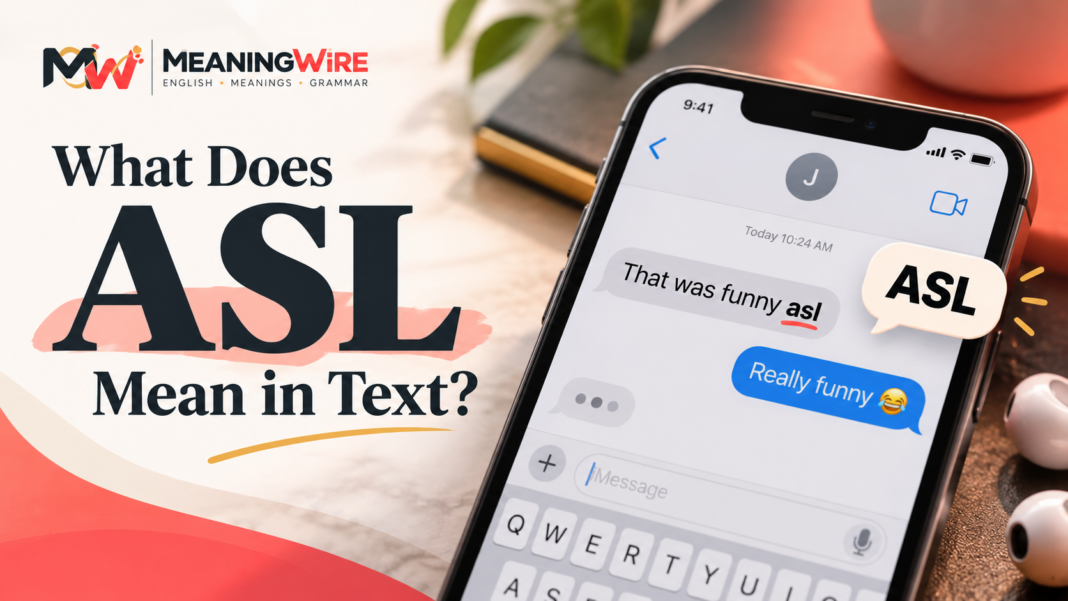
Someone replies to your video with funny asl. A stranger sends just ASL?. Your friend mentions an ASL class. Same three letters, three completely different messages. In texting, asl often means “as hell,” a casual way to emphasize something. ASL can also mean “age, sex, location” in online chat, or American Sign Language when people discuss communication.
The secret isn’t memorizing three definitions. It’s noticing where the letters appear. One short phrase can tell you whether someone is excited, asking a personal question, or talking about a language. Once you spot the clues, these messages stop looking confusing.
The Three Meanings, Side by Side
funny asl
as hell
An emphatic way to say something is extremely funny.
ASL?
age, sex, location
A request for basic personal details, associated with older chat rooms.
learning ASL
American Sign Language
A complete signed language used in Deaf communities.
These are context clues, not an ironclad capitalization rule. People type in all lowercase or all caps for plenty of reasons. The surrounding sentence matters more than the keyboard setting.
When “asl” Means “As Hell”
In modern social posts and casual messages, lowercase asl commonly follows an adjective. It makes the description stronger without adding another full phrase. Think of it as a shorter, more informal version of really, extremely, or the expression as hell.
That final scene was wild asl
I did not see that ending coming either!
Here, wild asl simply means very wild or surprisingly intense.
You’ll see similar wording in comments about music, sports, movies, clothing, jokes, or everyday frustrations. It often sounds natural in a quick chat between friends. It can sound out of place in a school assignment, a professional email, or a formal presentation.
Examples That Sound Natural
- That coffee is strong asl. The speaker thinks the coffee tastes extremely strong.
- I’m nervous asl before the interview. The speaker is very nervous.
- These tickets were expensive asl. The speaker is emphasizing the high price.
- That dog is cute asl. The speaker finds the dog especially cute.
- It’s cold asl today. The speaker wants you to know the weather feels very cold.
You do not need to translate the phrase literally word for word each time. Its job is emphasis. Sometimes it’s enthusiastic, sometimes frustrated, and sometimes exaggerated for humor. The adjective and tone determine the mood.
Why “as hell” Has a Casual Tone
The underlying phrase contains a mild swear-related expression. Many readers treat it as everyday slang, but not every audience welcomes it. If you’re writing to a teacher, client, coworker, or someone you don’t know well, choose very, incredibly, or extremely instead.
For example, a friend might text The lines were long asl. An email to an event organizer would sound more appropriate as The lines were extremely long. Same basic complaint, different level of formality.
When “ASL?” Asks for Personal Information
Earlier generations of internet users commonly typed A/S/L? or ASL? to ask for a person’s age, sex, and location. It served as a fast introduction in chat rooms where users often knew almost nothing about one another. You may still encounter it in older screenshots, nostalgic conversations, some direct messages, or jokes about early internet culture.
OLD-SCHOOL CHAT EXAMPLE
Hey, ASL?
I’d rather not share personal details online.
An ASL request does not obligate anyone to reply with private information.
The abbreviation reflects the wording and social conventions of older chat culture. The sex part of the historical phrase is dated language for a basic identity question, and it isn’t necessarily how people would ask for someone’s identity today. If you’re discussing the term in a history or media class, explain the original expansion accurately rather than quietly replacing it with a different phrase.
Do You Need to Answer an ASL Request?
No one owes a stranger their age, gender information, or location. Even a city name can reveal more than you intend when combined with other profile details. You can ignore the message, decline politely, or continue the conversation without personal specifics. A simple response such as I’d rather keep that private is enough.
If an unfamiliar account repeatedly pushes for details, use the platform’s privacy and safety tools. A request that seems playful can still be invasive, particularly for younger users.
When ASL Means American Sign Language
In classrooms, accessibility discussions, Deaf culture, interpreting, and language study, ASL usually refers to American Sign Language. This is not an internet slang expression. It is a distinct language with its own grammar and linguistic structure. It isn’t simply English translated into hand gestures.
Imagine a friend texts I’m taking ASL next semester. They’re talking about studying a language, not asking for someone’s age or describing something as intense. Context settles the meaning immediately.
ASL is used across the United States and parts of Canada. It matters in education, communication, culture, and accessibility. If someone mentions an ASL interpreter, conversation practice, or a Deaf community event, the language meaning is the right starting point.
The National Association of the Deaf’s ASL resources provide more context about the language and its importance. Treat this meaning with the same respect you would give any spoken language.
How to Decode ASL in Three Seconds
Rather than memorize a complicated chart, look at how the letters behave in the sentence.
- Look just before it. If an adjective appears immediately before asl, such as tired asl, the writer likely means as hell.
- Notice the question. A standalone ASL? from a stranger might be the older age, sex, location question.
- Read the subject. A message about classes, interpreters, or Deaf culture points to American Sign Language.
Quick check: This playlist is good asl expresses enthusiasm. Do you study ASL? asks about a language. ASL? sent by an unknown account may request personal details. Same letters, three different purposes.
The rule works on text messages, Snapchat, TikTok, Instagram, Discord, and many other spaces. Don’t assume a platform always determines the meaning. A TikTok comment about an ASL lesson still refers to American Sign Language, even though TikTok also hosts slang using asl.
The Small Details That Change the Meaning
Capital Letters Offer Clues, Not Proof
People often write asl in lowercase when they mean as hell, and ASL in uppercase when discussing the language or older chat abbreviation. But phones auto-capitalize, usernames appear in unusual styles, and some writers type everything in lowercase. Let grammar and context make the final decision.
The Place of the Word Matters
When slang asl follows an adjective, it functions as an intensifier: loud asl, good asl, or busy asl. The older personal-information abbreviation often appears as a question on its own. The language name usually acts as a noun modifier, as in ASL instructor or ASL course.
Not Every Message Is Friendly
A person who says You’re funny asl may be complimenting you. Someone who says You’re annoying asl is probably criticizing you, even though the abbreviation works the same way. Understanding the grammar doesn’t automatically tell you the speaker’s intention. Read the full conversation and relationship.
How to Reply Without Sounding Awkward
If someone writes That outfit is fire asl, a relaxed response such as Thanks, I appreciate it! fits. You don’t have to mirror slang to show that you understand it. If the person sends ASL? and you don’t know what they mean, ask Do you mean American Sign Language, or are you asking something else? Clarifying is normal.
For a question about American Sign Language, answer the actual topic. You could say I’ve been interested in learning ASL or I’m looking for an introductory course. Correct interpretation makes your response feel natural, not rehearsed.
These examples are illustrative, not records of actual conversations. They show how a small abbreviation changes the direction of a message.
Don’t Confuse ASL With Other Text Shortcuts
Internet abbreviations sometimes sit next to one another in conversations. For example, TBH often introduces an honest opinion, HMU commonly invites someone to contact you, and AF is another emphatic intensifier that may be considered stronger or more explicit than asl. None of these automatically mean the same thing in every sentence.
Even familiar abbreviations can change meaning between friends, professions, and communities. Context matters more than guessing from the letters. A short online dictionary entry can help, but the actual message remains the best clue. Dictionary.com’s ASL entry records both the older chat abbreviation and its slang usage.
Grammar and spelling matter in short messages too. A small mark can change meaning, much like the difference covered in our its vs. it’s guide. You don’t need perfect punctuation in every text, but attention to context prevents many misunderstandings.
Read the Message, Not Just the Letters
When you see asl after an adjective, read it as emphasis first. When you see ASL? from someone you don’t know, consider whether they’re requesting personal details. When the conversation turns to Deaf culture, interpreters, or language lessons, recognize American Sign Language.
That’s the practical skill worth keeping. Internet English changes quickly, but the best readers don’t race to assign one meaning to every abbreviation. They look at the words around it, the person speaking, and the purpose of the message. With ASL, those clues are usually enough.

[…] you’re curious about another common abbreviation, our ASL texting guide shows how the same letters can carry several meanings. In casual messages, the words around an […]