

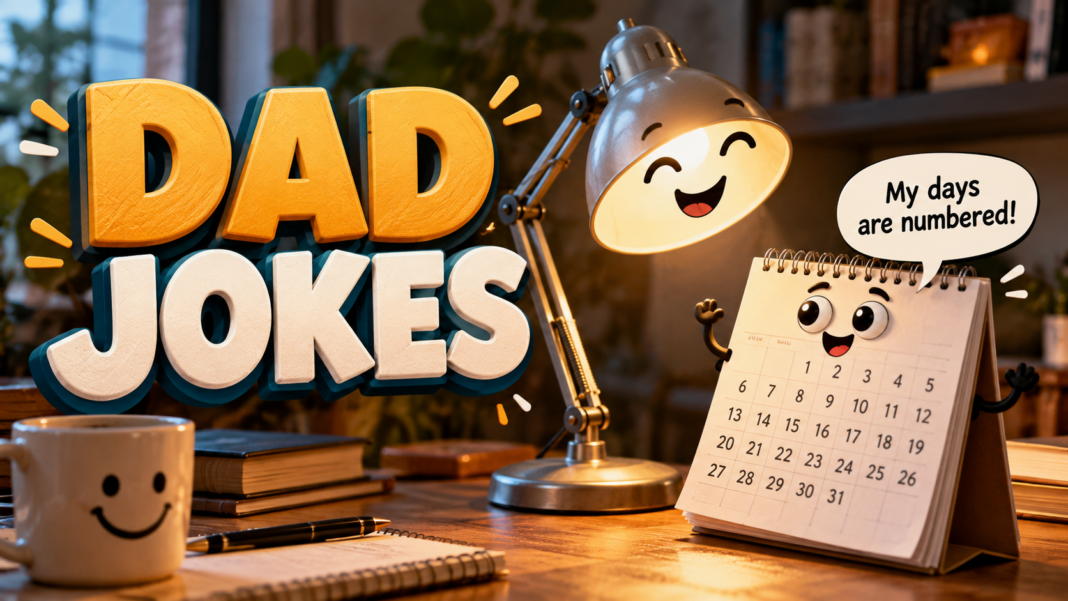
Dad jokes are short, deliberately corny jokes with simple wordplay, predictable twists, and punch lines that can make people laugh or groan. You don’t have to be a father to tell one. Anyone who loves a harmless pun can enjoy this style of humor.
Try this one: I asked my calendar if it needed a vacation. It told me its days were numbered.
That double meaning is the secret. A calendar literally contains numbered days, but saying someone’s days are numbered can also mean time is running out.
Short dad jokes for a quick laugh
These jokes are easy to remember. Deliver them with a straight face, leave a brief pause, and let the person listening make the connection. A little silence before the last word often helps the punch line land.
- I gave my chair a compliment. It was really supportive.
- My umbrella is a loyal friend. It always covers for me.
- I asked my flashlight to explain itself. It finally shed some light on things.
- My plant wanted to be an actor. It thought it could grow into the role.
- My notebook went on a diet. It wanted fewer loose sheets.
- My alarm clock has no patience. It always goes off too soon.
- I tried to race a cloud. It drifted out of the competition.
- My bookshelf loves helping others. It always supports a good story.
- The elevator made a joke. It worked on several levels.
- My pencil wanted another chance. It said mistakes could be erased.
Not all ten jokes have exactly the same mechanism. The chair is supportive both physically and emotionally. The umbrella provides cover from rain but also “covers for” someone in the sense of protecting them from blame. The elevator moves between floors, or levels, and a sentence can also have several levels of meaning.
Question-and-answer jokes kids can tell
Children can turn these into tiny guessing games. Ask the question first and give everyone time to imagine a serious answer before sharing the silly one. If a joke depends on an unfamiliar expression, explain the phrase afterward rather than making the child feel they missed something obvious.
What did the ruler say to the crooked line?
“You need to straighten things out.”
Why did the backpack request a holiday?
It was carrying too many problems.
What did the window say to the other window?
“I can see right through you.”
Why did the spoon become a party host?
It knew how to stir up a conversation.
What did the clock want after school?
A little time off.
Why did the little apple join the orchestra?
It wanted to improve its core skills.
“Straighten things out” can mean fixing a problem or making something physically straight. The spoon joke uses “stir up a conversation,” a phrase for making people talk, alongside the literal act of stirring food. Simple examples like these can help children notice that one English expression may work in several settings.
Food dad jokes to share at dinner
Food offers plenty of wordplay because cooking words also appear in everyday phrases. We talk about earning dough, having something on our plate, and feeling sour after a disappointment. These familiar expressions become funny when a food item behaves like a person.
- My sandwich applied for a job. It wanted to bring something to the table.
- I asked the lemon to cheer up. It said life had been sour lately.
- My soup ran for class president. It wanted to stir up support.
- The popcorn couldn’t keep a secret. It was about to burst.
- My toast became a comedian. Its humor was a little crumby.
- The bread joined a band. It had always wanted to make some dough.
- My cereal became a detective. It was excellent at tracking missing flakes.
- I told my cookie to stay positive. It said it was feeling crummy.
Food puns work especially well when the listener already knows the two meanings. “Dough” is a mixture used to make bread, but it is also an informal term for money. “Sour” describes a sharp taste as well as an unpleasant mood. You can make a similar joke with a new food simply by finding a familiar expression that belongs to it.
School jokes and office one-liners
Sometimes the best jokes come from ordinary frustrations. A printer that jams, a meeting that runs late, or a school notebook with missing pages offers a familiar starting point. Workplace jokes are usually safer when the joke is about an object or situation rather than a particular coworker.
- The whiteboard had big ideas, but nothing seemed to stick.
- My computer asked for a break. It had too many tabs open in its life.
- The printer loves drama. It makes a scene whenever paper runs out.
- Our meeting about clocks lasted forever. Nobody had time to discuss time.
- The school library is great at keeping secrets. Everything stays between the covers.
- My backpack knows all my problems. It’s been carrying them for years.
- My desk said I should work harder. I told it to stop standing in my way.
- The math book requested a day off. It had too many problems.
The last joke uses the difference between math problems and personal problems. A math book contains questions to solve, but the phrase “too many problems” normally makes us think of stress. The listener switches meanings halfway through the sentence, which creates the humor.
How dad jokes use English wordplay
A pun is a playful use of words with similar sounds or different meanings. Many dad jokes rely on a pun, although some use a simple literal interpretation instead. The more familiar the original expression, the easier it is to understand the joke.
| Joke | Two meanings |
|---|---|
| The gardener’s advice really grew on me. | Plants grow; an idea can become more appealing over time. |
| The baker needed more dough. | Dough means bread mixture or money. |
| The elevator joke works on many levels. | Levels can mean floors or layers of meaning. |
| My calendar’s days are numbered. | Days have printed numbers; the phrase can also mean limited time remains. |
Some jokes rely on words that sound alike but have different spellings, called homophones. Flower and flour provide a simple example. Saying “I brought flour to brighten the room” invites someone to imagine flowers until the joke reveals a bag of baking flour. This type of joke may work better aloud because the written spelling can reveal the answer early.
What makes a joke a dad joke?
Cambridge Dictionary describes a dad joke as a simple joke that often relies on puns and can be intentionally corny. See its dad joke definition. Dictionary.com also identifies the expression with corny jokes and wordplay typically associated with fathers and children, as its usage guide explains.
That description does not mean every father tells jokes or every dad joke must be told by a father. The name refers to an expected style: a harmless, easy-to-follow setup, a deliberately obvious twist, and a teller who may be as amused by the audience’s groan as by their laughter.
A riddle usually asks you to solve a puzzle. Sarcasm often depends on the speaker meaning something different from the literal words. Dad jokes are more playful than mysterious or critical. Their simplest form takes a normal expression and places it in a situation where the literal meaning suddenly becomes possible.
Make a dad joke from any ordinary object
You don’t need to memorize a hundred punch lines. Look around the room and choose an ordinary object, then think about words connected to it. A lamp is bright. A book has a spine. A shoe has a sole. Each description can also suggest a more human meaning.
- Choose an object. Start with a lamp.
- Find a double meaning. Bright can mean giving off light or being smart.
- Create a natural setup. “My lamp aced the test.”
- Save the twist for last. “It has always been bright.”
Try another example with a shoe. “My shoe is a wonderful friend. It has real sole.” Here sole is part of footwear, but it sounds like soul, which can suggest someone’s inner character. The joke depends on sound, so it is easier to deliver verbally than to explain on paper.
A useful editing trick is to remove words before the punch line. “My lamp was very bright and that’s why it got a good grade” spoils its own surprise. “My lamp aced the test. It was always bright” makes the listener connect the two meanings independently.
Pick the right joke for the situation
A small joke can lighten a road trip, family gathering, or casual message. Context still matters. Young children may enjoy easy object jokes. Adults can appreciate a clever double meaning. Someone discussing bad news may not want a joke at all, even one that’s completely harmless.
On a phone, a question in one text and the punch line in the next can recreate the pause of a spoken joke. Different kinds of internet language have their own conventions. Expressions such as HMU and ASL are abbreviations, not dad jokes, and should not be treated as punch lines simply because they appear in texts.
If your audience smiles, that’s great. If they roll their eyes and say “Dad!”, you may have achieved exactly the response you wanted. The pleasure often comes from sharing the joke, even when everyone sees the ending coming.
