

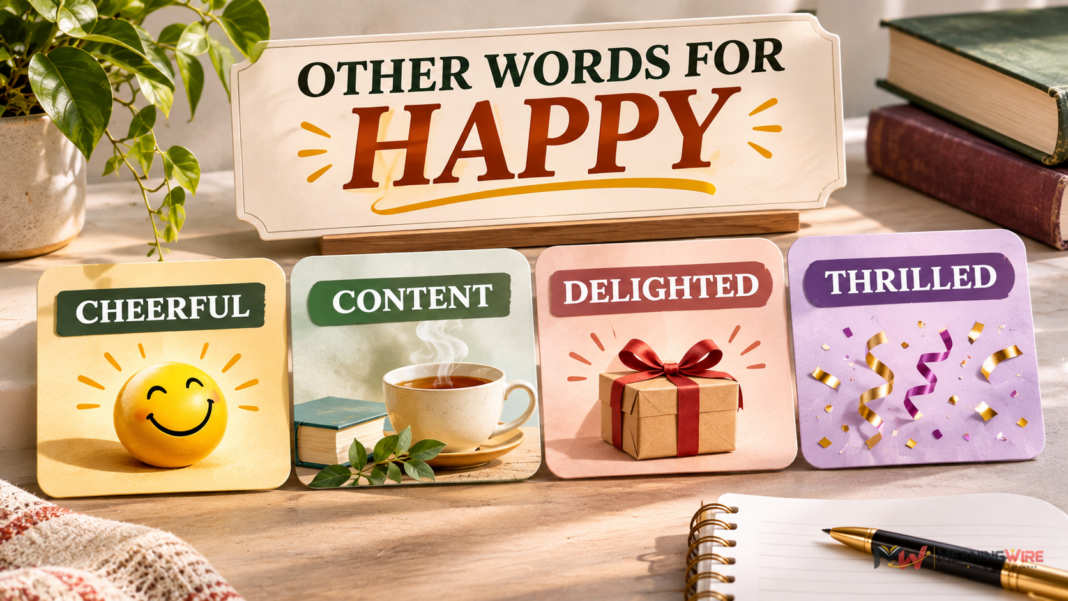
Happy has more than one shade of meaning. You might feel delighted after good news, content with a quiet afternoon or relieved when a difficult week ends. These words are close to happy but they do not tell the same story. The best synonym depends on what caused the feeling and how strong it is.
For everyday writing, start with glad, pleased, cheerful, joyful, content, delighted, thrilled, elated or satisfied. Each word earns its place in a different sentence. Use the guide below to make that choice without making your writing sound unnatural.
Pick a word for the feeling
A strong substitute does more than make a sentence sound different. It gives the reader a more precise picture. Someone who smiles through a busy Monday is cheerful. Someone who has finally finished a hard task may be relieved. A person who loves the result of a project can be satisfied or pleased.
A quick word chooser
Delighted or thrilled
Content or contented
Cheerful or upbeat
Pleased or satisfied
This distinction agrees with the usage notes in the Oxford Advanced Learner’s Dictionary. Its comparison of happy with pleased, glad, thrilled and content makes clear that these words describe different kinds of positive feelings.
Friendly words for daily conversation
Glad
Glad is a simple choice when something good happens or you are thankful for a result. It often follows to or a clause about what happened. I’m glad you got home safely. We’re glad to help. You would not normally describe someone as a glad coworker in everyday English. Cheerful sounds better before a noun.
Pleased
Pleased suggests a positive reaction to an event, effort or result. It feels natural in polite emails and conversations. I’m pleased with the final design. Her parents were pleased to hear the news. It usually sounds calmer than thrilled. Use it when you approve of something but do not want to exaggerate your reaction.
Cheerful
Cheerful describes a pleasant mood that other people may notice. A cheerful person might speak warmly and smile often. He stayed cheerful during the long trip. It can describe a person’s usual manner as well as a temporary mood. Someone can act cheerful even if they have worries.
Upbeat
Upbeat adds a sense of hope and positive energy. It works well for a person, message or tone. She gave an upbeat update after the meeting. A person can sound upbeat about future plans without feeling joyful right now. That hopeful edge makes the word useful in work and casual writing.
These are flexible alternatives for ordinary messages. You do not need a dramatic word if you only mean someone had a good day. The Cambridge English Thesaurus also groups cheerful, pleased and glad among the close alternatives to happy.
Words for excitement and big news
Delighted
Delighted suggests strong pleasure, often because you received good news or a welcome invitation. I’m delighted that you can join us. It sounds warm in personal messages and professional announcements. It is stronger than pleased but not always as intense as ecstatic.
Thrilled
Thrilled combines happiness with excitement. Maya was thrilled to win the scholarship. People often use it when they achieve a goal or receive something they hoped for. It may feel too strong for ordinary events. Being thrilled about finding your keys can work as a joke but may sound exaggerated in formal prose.
Elated
Elated describes a lift in mood after especially good news or success. He felt elated after passing the final exam. This word is more intense than glad. Use it for a moment that genuinely deserves the extra energy.
Ecstatic
Ecstatic sits near the top of the intensity scale. The fans were ecstatic after the last-second goal. It suggests overwhelming joy or excitement. It can sound excessive when the situation is routine. If a customer merely approves of a purchase, pleased or satisfied is usually more believable.
Overjoyed
Overjoyed expresses very great happiness, often in connection with something personal. Her grandparents were overjoyed to meet the baby. It can work for emotional reunions or long-awaited news. It does not necessarily describe loud excitement. A person can be quietly overjoyed.
Jubilant
Jubilant often relates to celebration after victory or success. The team was jubilant after winning the championship. It is especially useful when a whole group shares the feeling. An ordinary private moment of comfort rarely calls for jubilant.
These words are not equal in strength. If you replace happy with ecstatic every time, the reader loses a sense of which moments matter most. Save intense words for intense reactions.
Quiet happiness has its own vocabulary
Not every happy moment calls for a party. Some describe a calm sense that life is fine as it is. These alternatives focus on comfort or satisfaction rather than excitement.
Content
Content describes being satisfied with a situation. He was content with a simple weekend at home. The word often suggests that a person does not feel a need for something more at that moment. It is a useful contrast to thrilled because it carries little sense of excitement.
Contented
Contented is close to content but often describes a settled state or manner. She gave a contented sigh after dinner. You may describe a contented child or a contented smile. The difference is small but the word often fits a calm scene well.
Satisfied
Satisfied says a need or expectation has been met. I’m satisfied with the repair. A person may be satisfied without feeling cheerful. This makes it a stronger choice for product reviews, work evaluations and decisions about whether something was good enough.
At ease
At ease means comfortable and free from tension. She finally felt at ease in her new apartment. It is related to happiness but not a direct replacement in every sentence. Feeling at ease describes comfort more clearly than pleasure.
Try the sentence He was happy with the answer. If the answer met his expectations, satisfied works well. If he loved the answer, delighted may fit. If he was simply grateful to receive an answer, glad could be better. Choose according to the actual reaction.
Happy words that need extra care
Some words appear in synonym lists even though they change the meaning. Understanding the difference will improve your writing more than memorizing another twenty terms.
- Relieved means worry or pressure has eased. A person can feel relieved and exhausted at the same time.
- Proud means pleased with an achievement, effort or connection. It does not describe every happy moment.
- Grateful means thankful for help or kindness. It describes appreciation rather than happiness alone.
- Optimistic means hopeful about what may happen. Someone can be optimistic during a difficult day.
Consider a message about a friend’s recovery. I’m glad you’re feeling better sounds natural. I’m relieved you’re feeling better adds the idea that you were worried before. I’m proud you’re feeling better sounds odd unless the person made a difficult effort you want to recognize.
Better choices for work and email
Happy appears often in emails because it is friendly and easy to understand. Yet the word may be vague when you need to express a specific response.
| Ordinary sentence | More precise version |
|---|---|
| I’m happy with the report. | I’m pleased with the report. |
| We are happy to welcome you. | We’re delighted to welcome you. |
| I’m happy the issue is fixed. | I’m relieved the issue is fixed. |
| The client was happy with the result. | The client was satisfied with the result. |
These edits assume a specific feeling. If you have not confirmed what the client felt, do not upgrade happy to delighted or thrilled. Strong words should describe the real situation. Professional writing works best when the emotion is accurate.
You can apply the same principle to other overused adjectives. Our guide to better words for important shows why the context matters more than a longer synonym list.
Natural alternatives in personal messages
Warm personal messages often need a gentler word than ecstatic. I’m so glad we met sounds personal without exaggeration. I’m grateful for the time we spend together adds appreciation. I feel content when we’re together suggests peace and comfort.
A birthday message might say I’m delighted to celebrate with you. A note after a difficult day could say I’m relieved everything worked out. For someone close to you, the right words depend on your relationship and how openly you usually express affection.
If you want a phrase that says more than an emotion, our personal ways to express love guide offers wording for close relationships. A synonym for happy is useful but it may not communicate care on its own.
Common mistakes in word choice
One mistake is treating happiness as a single scale from weak to strong. A satisfied customer and a cheerful friend are not necessarily at different levels of the same feeling. They may feel different things altogether. Think about approval, energy, relief and excitement before you choose a replacement.
Another mistake is using an adjective in the wrong position. She is glad is fine. A glad student sounds less natural than a cheerful student or a happy student in ordinary modern English. By contrast, a delighted customer is natural.
Use nouns and verbs correctly too. You can say He felt joy or He was joyful. You cannot use the noun joy as though it were the adjective joyful. Similarly, She felt excitement and She was excited are different structures.
Do not replace every instance of happy in a finished article. Repetition can be worth fixing but a simple accurate word is often better than an impressive one that misses the meaning.
Test five situations
Try choosing a word before you read the suggested answer. Each sentence gives you a clue about the kind of happiness involved.
- A family finally hears that a missing dog has been found safe.
- A student wins a scholarship after months of effort.
- A neighbor enjoys a slow afternoon with no plans.
- A manager approves a finished design.
- A crowd celebrates a championship victory.
See suggested answers
1. Relieved. The family was worried and that worry has ended.
2. Thrilled or elated. The student has exciting personal news.
3. Content. The person is at peace with a simple moment.
4. Pleased or satisfied. The design meets the manager’s expectations.
5. Jubilant. The celebration comes from a shared victory.
More than one answer may fit a situation. That is normal. The goal is to pick a word that gives the reader a clearer picture, not to prove that happy is the wrong word.
