

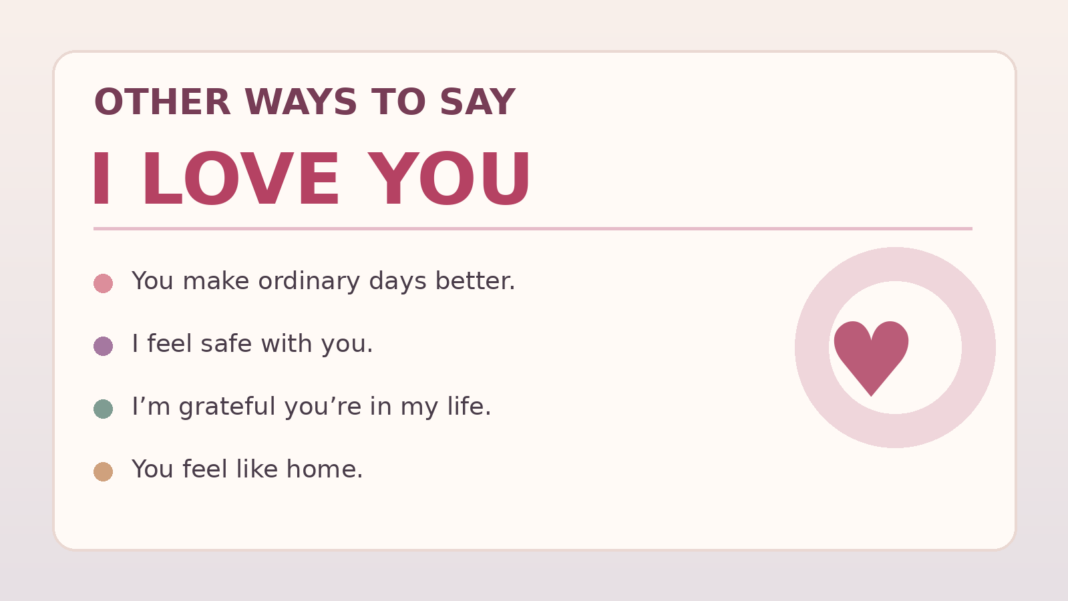
“I love you” is clear and meaningful, but sometimes a more personal sentence says exactly what you feel. “I feel safe with you,” “I’m grateful you’re in my life,” and “You make ordinary days better” express affection in different ways. The best alternative depends on your relationship, the moment, and whether you want to sound romantic, warm, playful, or reassuring.
These phrases are original examples you can adapt for a partner, family member, or close friend. They are not all direct synonyms. “I’m proud of you” offers encouragement, whereas “I want to build a life with you” communicates a much stronger commitment. Choose words that match what you genuinely mean.
Romantic ways to express your love
Romantic words work best when they refer to something real about your relationship. A short line about feeling understood can sound more intimate than an elaborate statement about destiny.
“My favorite part of the day is getting to tell you about it.”
This says the person is part of your everyday life, without turning a simple feeling into a grand promise.
- “Being with you feels like home.”
- “I choose you, even on the ordinary days.”
- “You make my world feel brighter.”
- “I can’t wait to see what we build together.”
- “I love the way you see the world.”
- “Life feels better when I get to share it with you.”
- “I still get excited when I see your name on my phone.”
- “You are my favorite person to do nothing with.”
- “I feel understood when I’m with you.”
- “You make the small moments matter.”
Some sentences describe present feelings; others imply a shared future. “I choose you” can suggest commitment, so it may suit a long-term relationship more than an early date. “I like how you see the world” feels lighter and can be more natural when you’re still getting to know each other.
Sweet phrases for a text message
A thoughtful text doesn’t need an elaborate opening. One detail about the other person, or a reference to your shared day, can make a short message feel genuine.
Illustrative text messages
Other natural messages include “I wish you were here,” “Thinking of you made me smile,” “I miss your laugh,” and “Please text me when you get home.” That last message often communicates care, but context matters: a thoughtful safety check should not become pressure to report every movement.
Short slang phrases can be affectionate too, but they’re not substitutes for every serious conversation. MeaningWire’s guide to HMU meaning in text explains an invitation to get in touch; it doesn’t mean “I love you.” Knowing the difference prevents a casual message from sounding more emotionally committed than intended.
Show love through gratitude and attention
Affection is not always a declaration. Thanking someone for a specific action can make them feel seen, particularly if they have been quietly helping you for a long time.
- “Thank you for listening when I needed someone.”
- “I notice how much you do for us.”
- “You make difficult days easier to face.”
- “I’m grateful for how patient you were with me.”
- “I appreciate the little things you remember.”
- “I trust you with the parts of my life I don’t usually share.”
- “I feel lucky to know you.”
Specificity makes the words stronger. “You’re amazing” is a pleasant compliment. “You remembered my appointment and checked in afterward. That meant a lot” names the caring action and its effect. Neither has to replace “I love you”; they can deepen what it means.
Affectionate words for family members
A message to a parent, sibling, grandparent, or child often needs a different tone from a romantic note. Affection can mean reassurance, pride, gratitude, or a reminder that someone belongs.
To a parent or caregiver, you might write: “Thank you for making room for me to become myself,” or “I understand more of what you did for me as I get older.” Those sentences acknowledge the relationship without assuming every family history is uncomplicated.
To a child, “I love spending time with you” and “You can always talk to me” can be reassuring. “I am proud of the way you kept trying” praises effort rather than suggesting that love depends on success. Children also benefit from hearing a direct “I love you,” so indirect expressions should complement it, not always replace it.
To a sibling, try “I’m glad we grew up together,” “You’re still the person I want to tell first,” or a shared joke that only the two of you understand. An inside joke can carry affection without sounding like a greeting card.
Let close friends know they matter
Deep friendship can include love without romance. Phrases such as “You’re my person” or “I don’t know what I’d do without you” sometimes sound romantic, depending on the relationship and context. Less ambiguous wording may fit better when you want a purely friendly tone.
- “I’m really glad we’re friends.”
- “You make hard weeks more manageable.”
- “Thanks for always being honest with me.”
- “I can be myself around you.”
- “Our conversations always make my day better.”
- “You’ve been there when it mattered.”
- “I hope you know how much I value our friendship.”
A friend going through a difficult period may appreciate “I can bring dinner on Thursday” more than a poetic statement. A concrete offer gives them something useful while still expressing care. Affection can be shown through action and language together.
Expressing love without sounding overly dramatic
Big phrases can be beautiful, but they may feel out of place in a normal exchange. “You are the reason I exist” makes a sweeping claim and can place uncomfortable emotional weight on another person. “I really enjoy the life we’re making together” is warmer and more grounded.
| Very intense wording | Natural alternative |
|---|---|
| I cannot survive without you. | I miss you and look forward to seeing you. |
| You are perfect in every way. | I love the things that make you who you are. |
| Nothing matters except you. | You are an important part of my life. |
Strong language is not automatically wrong. Poetry and deeply personal letters may call for intensity. Everyday communication usually benefits from honest words that don’t turn affection into an obligation.
Different tones for different occasions
A birthday card might say “Every year with you gives me another reason to be grateful.” An anniversary note could say “I still love learning new things about you.” After a disagreement, “I care about us, and I want to understand what happened” may be more useful than an elaborate romantic message.
Careful wording matters because love and apology are not the same thing. “You know I love you” does not replace taking responsibility if you have hurt someone. A better response names what you did, acknowledges its effect, and explains what you intend to change. Affection can accompany an apology, but it should not be used to avoid one.
On a difficult day, simple reassurance often sounds best: “I’m here,” “You don’t have to handle this alone,” or “Tell me what would help.” These statements make room for the other person rather than assuming you already understand their feelings.
Words that convey different levels of affection
English distinguishes several related feelings. Adore can express strong fondness, cherish suggests holding someone or something dear, and appreciate emphasizes gratitude or recognition. Care for can mean feeling affection or providing practical care, depending on the sentence.
Cambridge Dictionary defines adore as loving someone very much or liking something very much. Its entry for cherish connects the verb with loving, protecting, or caring deeply for someone or something. Those definitions explain why “I adore you” can sound warmly romantic and “I cherish our friendship” can feel more reflective.
“I’m fond of you” is gentler and can sound reserved in some American English situations. “I appreciate you” is common as thanks, but it may not communicate romantic love. “I’m crazy about you” is more playful and typically conveys strong attraction. Choose a phrase that reflects your actual intention rather than treating every word as an exact synonym.
Make your message personal in three steps
Pick one quality or action you genuinely value. Add a specific moment that shows it. Then say how that moment affected you. This produces a message that another person is unlikely to mistake for a generic caption.
- Quality: “You’re thoughtful.”
- Moment: “You remembered I had a difficult meeting.”
- Meaning: “Your message afterward made me feel supported.”
Put the parts together naturally: “You remembered my meeting and checked in afterward. That made me feel really supported.” It is a form of affection even without the words “I love you.” If direct words feel right, you can add them at the end.
No phrase fits every relationship. The most convincing expression of love is often the one that sounds like something you would genuinely say, supported by how you treat the person when the conversation is over.

[…] a less playful note, see our guide to personal ways to say I love you. It covers direct affectionate wording without relying on a […]