

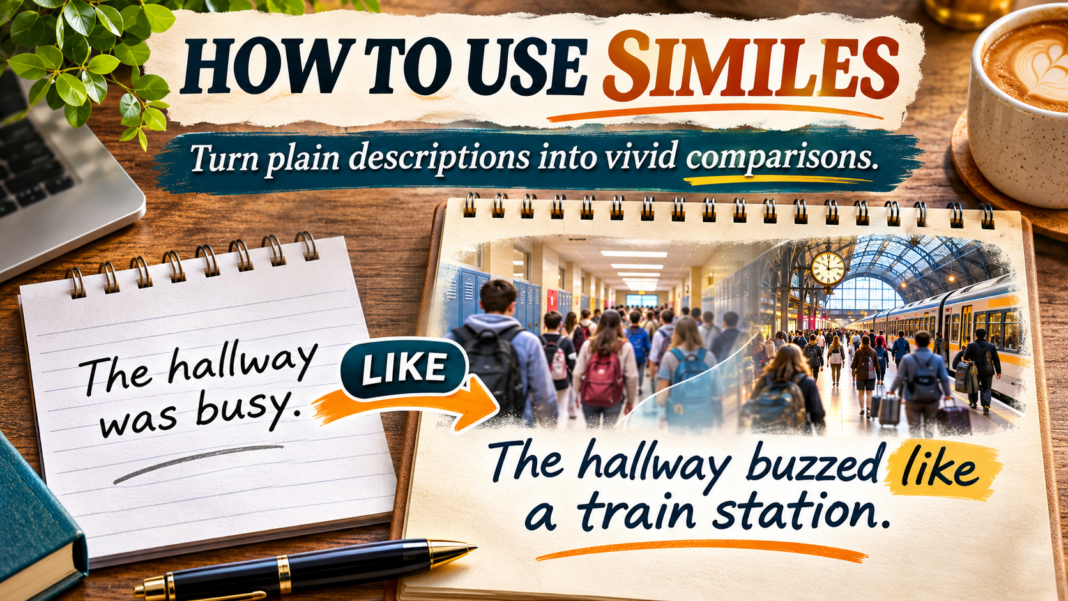
The trick to using a simile is to choose a comparison that tells readers something specific. The hallway was busy gives a basic fact. The hallway buzzed like a train station before departure adds sound, movement and a sense of urgency. A strong simile makes a scene easier to imagine. It should not make readers stop to figure out what you meant.
To write one, identify a clear quality, find a familiar thing with that quality and connect the two with like or as. Then test whether the comparison fits the mood and adds useful detail. That process works for stories, poems, descriptions and personal essays.
Start with the detail you want readers to notice
A simile is a figurative comparison between different things. It usually uses like or as. The Cambridge Dictionary definition of simile describes that comparison. The important part for a writer is the shared quality.
Suppose you want to describe an old door. You could say it was as hard as a rock, but that does not reveal much about how it looks or behaves. Maybe its hinges shriek when it opens. A more precise sentence would be The old door squealed like a startled bird. The reader can almost hear it.
Before reaching for a familiar comparison, write down what matters in the scene. Is the door heavy, loud, fragile, crooked or difficult to open? Your answer should guide the object you compare it to. A simile succeeds when those two details connect naturally.
Build a simile in four moves
From plain description to a clear image
- Name the subject. A candle flame.
- Choose one noticeable quality. It flickers and bends in a draft.
- Find a familiar comparison. A small flag caught in the wind.
- Write and test the line. The candle flame bent like a tiny flag in the draft.
Notice what the comparison accomplishes. A flag moves because of air, just as the flame does. It suggests shape and motion without a long explanation. A different comparison could change the mood. The flame shivered like a frightened child gives the same physical movement an emotional tone. Neither is automatically better. Choose the one that suits the passage.
A useful exercise is to list three possible comparisons before choosing one. If you describe rain, you might think of pebbles on a roof, fingers on a window or a curtain across a street. Each suggests a different sound or sight. The task is not to find the fanciest object. It is to find the most accurate image for the moment.
Turn flat sentences into vivid ones
Similes work especially well when a sentence has a vague adjective such as nice, bad, fast or scary. Start with what a character actually sees, hears or feels. Then use a comparison only if it gives the reader something a direct description cannot.
Three original revisions
Plain: The bus was crowded.
Revised: People pressed together like books jammed onto an overfilled shelf.
Plain: Her hands were cold.
Revised: Her fingers felt as cold as coins left outside overnight.
Plain: The announcement spread quickly.
Revised: The news moved through the cafeteria like a ripple across a pond.
The first comparison describes tight spacing. The second adds touch. The third suggests a message moving outward from one point. Good descriptions usually have a purpose. They establish setting, reveal a feeling or make an action clear. If a simile is vivid but unrelated to that purpose, consider cutting it.
Many writers add a simile after they have already made the point with an adjective. That can feel repetitive: The room was freezing cold, as cold as ice. A tighter option is The room felt like a walk-in freezer. Or simply write The room was freezing. A comparison is not required for every strong sentence.
Use the senses without losing the scene
Readers build mental pictures from concrete details. The Purdue Online Writing Lab guide to descriptive essays recommends clear language and attention to sensory experience. A simile can make that advice practical when you choose an image drawn from sight, sound, touch, smell or taste.
For sound, try Rain tapped the porch roof like fingertips on a desk. For sight, The streetlights stretched down the wet road like a chain of small moons. For touch, The sweater scratched like dry grass against his wrist. These examples name an experience rather than merely praising it as beautiful or intense.
Smell and taste require more care. A comparison such as The soup tasted like a Sunday afternoon might work in a poetic passage, but it does not tell a reader much about the flavor. If flavor is the goal, use a concrete food comparison. The broth tasted as sharp as fresh lemon is more informative. The phrase does not need to surprise readers to be useful.
A useful rule is to let the scene supply your comparison. In a kitchen, dishes and ingredients may feel natural. In a forest, leaves, roots, water and wind may fit better. That does not mean every image must come from the same place. A surprising comparison can work if the shared quality is clear.
Let the comparison reveal emotion
A simile can describe a character’s feelings without using a label such as nervous or excited. Imagine a student waiting outside an interview room. Her thoughts scattered like papers caught in a gust suggests anxiety through movement and disorder. It gives readers an experience to interpret.
The same situation could sound hopeful: Her excitement rose like sunlight through the blinds. The imagery has a softer pace and a warmer tone. A writer should not choose between these lines based on which sounds more poetic. The choice depends on what the character feels.
It also matters whose point of view guides the story. A child might compare a tall building to a stack of enormous toy blocks. A mechanic might compare a faulty engine to a cough that cannot clear. Familiar objects reveal the way a character notices the world. That is often more interesting than borrowing a famous comparison from a list.
Our guide to simile examples for students offers more sentence ideas for describing people, places and emotions. Use them to study what makes the comparisons clear, then build examples from your own scene.
Keep similes different from literal comparisons
The presence of like or as does not automatically make a simile. My backpack looks like your backpack is usually a literal comparison of similar objects. My backpack felt like a sack of bricks is figurative. The writer compares a bag to a different object to suggest extreme weight.
Similarly, She is as tall as her sister describes a measurable similarity. She stood as still as a statue makes a figurative comparison to show a quality. Ask whether the sentence creates an imaginative link between unlike things.
Similes and metaphors also differ. A simile says The clouds were like torn cotton. A metaphor says The clouds were torn cotton across the sky. The metaphor makes the comparison directly rather than announcing it with like. Both can be effective, but they create different rhythms in a paragraph.
Choose a fresh comparison over a familiar one
Expressions such as busy as a bee, light as a feather and quick as lightning are easy to understand. Their familiarity can be helpful in everyday speech. In a story that needs a distinct voice, they may feel predictable.
You can improve a familiar simile by identifying the exact detail you want and finding another object that communicates it. Instead of The dog ran like lightning, you might write The dog shot across the yard like a ball released from a slingshot. The second version gives the movement a direction and a burst of speed.
Be careful with images readers may not recognize. A comparison drawn from a rare machine or a private family memory might require an explanation longer than the sentence itself. If readers must solve a puzzle to understand the image, the simile is probably doing too much work.
Also watch for comparisons that accidentally imply something negative. Describing a new employee as as quiet as a mouse may suggest fear or timidity, even if you only mean the person speaks softly. Choose your image based on the full set of associations it can bring, not just one quality.
Know when to leave similes out
Creative writing gives you room to experiment. A factual report usually needs direct language. Instead of saying Sales fell like a stone, a business summary should state the measured decline if that number is available. A scientific or technical explanation also benefits from precise terms before decorative comparisons.
Even in fiction, several similes packed into one paragraph can compete for attention. A reader who moves from a river to a drum to a bird to a glass wall in three sentences may lose track of the actual place. Keep the strongest image and let the other sentences describe the action plainly.
Read your draft aloud. If the comparison interrupts the sentence or sounds unlike the character, try a simpler version. A well-placed simile often appears effortless because it clarifies something the reader wants to understand.
Try this short revision exercise
Start with the sentence The crowd became loud when the doors opened. Think about the setting and the kind of noise you want to show. A cheerful crowd at a concert is different from an angry crowd outside a closed office. Pick one version and make the comparison serve that mood.
Here are two possible edits. The crowd roared like a stadium after a winning goal suggests celebration. The crowd surged and shouted like waves breaking against a seawall suggests force and danger. The comparison changes how the reader understands the same basic event.
Now write one from a place you know well. Choose a clear subject, decide what the reader should notice and test your image against the real action. If removing the simile leaves the sentence just as effective, leave it out. The goal is not to decorate every line. It is to make the right moment easier to see, hear or feel.
