

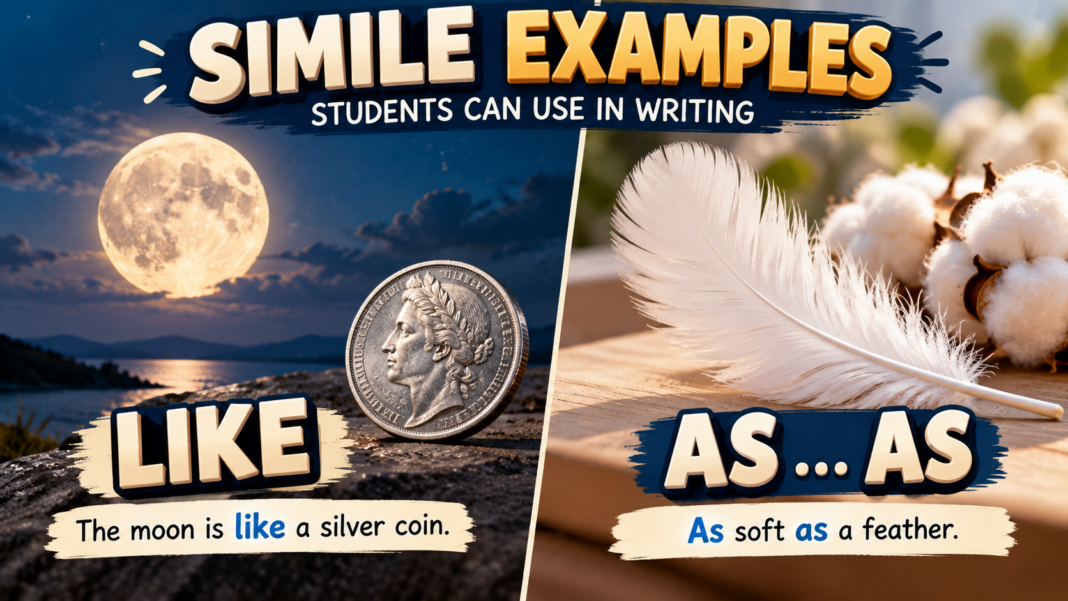
“Her backpack was as heavy as a boulder” is a simile because it compares a backpack to a boulder using as. Similes help readers picture an object, person, feeling, or action through a familiar comparison. Writers usually introduce the comparison with like or as, as the Cambridge Dictionary definition confirms.
Students can use similes in stories, descriptive paragraphs, poetry, and personal essays. The best comparison does more than add colorful words: it tells a reader something specific. Saying that a classroom was “like a beehive” suggests bustling activity, for example, whereas describing it as “as silent as a museum after closing” creates an entirely different scene.
Two quick examples
With like: “The moon floated like a silver coin above the rooftops.”
With as: “The hallway was as quiet as a library before opening.”
Easy simile examples for elementary students
Start with everyday things that children know: colors, animals, weather, toys, food, and school. Familiar comparisons make it easier to see the shared quality between two different things.
- The kitten was as soft as a cotton ball.
- His new sneakers were as white as fresh snow.
- She ran like a rabbit racing across the garden.
- The orange sunset glowed like a lantern.
- The puppy’s tail moved like a windshield wiper.
- The classroom clock ticked as steadily as a heartbeat.
- The blanket felt as warm as a sunny afternoon.
- Raindrops tapped the roof like tiny fingers.
- Her smile shone like a flashlight in the dark.
- The ice cube was as slippery as a wet fish.
- The balloon drifted like a feather in the wind.
- His pencil moved as fast as a racing car.
Ask a child to explain what is alike in each sentence. A balloon and a feather are different objects, but both can move gently through the air. Raindrops are not fingers, yet their tapping can sound similar. Identifying that shared feature is more useful than simply circling the word like.
Similes about people and their feelings
Emotions are difficult to see directly. A carefully chosen comparison lets readers experience them through movement, sound, temperature, or sensation. These examples work in narrative writing when a character needs more personality than “happy,” “angry,” or “nervous.”
| Feeling | Original simile |
|---|---|
| Excitement | Excitement fizzed inside her like bubbles in soda. |
| Nervousness | His thoughts scattered like papers caught in a gust. |
| Relief | Relief spread through her like warmth from a fireplace. |
| Loneliness | He felt as alone as the last chair in an empty room. |
| Determination | She stood as steady as a tree in a mild storm. |
Try placing one comparison in an actual scene. Instead of “Maya was nervous before her speech,” write: “As Maya stepped toward the microphone, her thoughts scattered like papers caught in a gust.” The second sentence helps the reader imagine the experience without needing a long explanation.
Nature similes for vivid descriptions
Nature offers a rich supply of shapes, movements, sounds, and colors. A landscape comparison works best when it fits the scene. A lake can be like glass on a calm morning, but it might look like crumpled foil when the wind rises.
- The lake lay as smooth as polished glass.
- Clouds rolled across the sky like slow waves.
- Autumn leaves swirled like confetti in a parade.
- Thunder sounded like furniture dragged across an attic floor.
- The river twisted like a ribbon between the hills.
- Fog covered the field like a thin gray blanket.
- The mountain stood as still as an enormous statue.
- Sunlight spilled through the branches like liquid gold.
- The wind hummed like a distant train.
- A narrow trail curled through the woods like a question mark.
Don’t use every image in a single paragraph. One strong simile can establish a mood. Three unrelated comparisons in consecutive sentences can distract from the setting. Let the most useful image lead, and describe the remaining details directly.
School, sports, and everyday actions
Action similes describe the way something happens. They can replace weak adverbs in stories and make the pace clearer. A student who “walked quickly” might instead “dart through the hallway like a fish slipping between rocks,” although this comparison should fit the actual scene.
- The basketball bounced like a drumbeat across the court.
- Her answer arrived as quickly as a camera flash.
- The new student held the map like a treasure hunter studying clues.
- He gripped the handlebars as tightly as a climber holds a rope.
- Pages fluttered like little flags in the classroom breeze.
- The lunch line moved as slowly as a sleepy turtle.
- The skateboard rolled like a small thundercloud over the pavement.
- Her fingers danced across the piano keys like raindrops on glass.
- The teacher’s instructions were as clear as a freshly cleaned window.
- The school bell rang like an alarm at a fire station.
Check the implied meaning. Comparing a lunch line to a sleepy turtle signals frustration at its slow pace. Comparing fingers to dancing raindrops suggests light, rapid movements. The comparison should match the action or the reader may form the wrong picture.
Simile or metaphor? Spot the difference
A simile states a comparison using like or as. A metaphor describes one thing as another without those comparison words. The two figures of speech can communicate a similar idea, but they have different sentence structures.
Simile: “The classroom was like a busy train station.”
Metaphor: “The classroom was a busy train station.”
Both suggest movement and noise. The simile signals the comparison openly; the metaphor states it directly.
Compare another pair: “Her voice was as soft as velvet” is a simile, and “Her voice was velvet” is a metaphor. Both may suggest a smooth and gentle quality. Neither should be taken literally.
One important exception is that not every sentence with like or as is a simile. “I like apples” expresses a preference. “She works as a teacher” names a job. “He looks like his brother” describes a straightforward resemblance, but in school literary analysis, a figurative comparison usually needs some creative or imaginative effect. The Cambridge grammar guide to as and like helps explain why these words have uses outside literary similes.
Turn plain sentences into stronger similes
A common writing mistake is to add a comparison that merely repeats what the adjective already says. “The ice was as cold as ice” adds little information. A more interesting comparison, such as “The metal railing was as cold as a stone pulled from a winter stream,” gives the reader a sensory detail.
Plain: The hallway was noisy.
Revised: The hallway buzzed like a crowded market.
Plain: He felt very tired.
Revised: His legs felt as heavy as soaked blankets.
Plain: The night was dark.
Revised: The path was as dark as the inside of a closed drawer.
These revisions don’t automatically fit every story. A crowded market suggests overlapping voices and movement, which may be too lively for a hallway where only one person is shouting. A good comparison serves the actual mood and detail of a scene, not just the desire to sound poetic.
A simple method to invent your own
Write down the thing you want to describe. Next, choose one feature that matters: color, sound, shape, speed, texture, or emotion. Then find a very different thing that shares the same feature. Connect them with like or as, and read the sentence aloud.
- Subject: the ocean at sunrise.
- Feature: an orange and gold shine.
- Comparison: a sheet of hammered copper.
- Sentence: “At sunrise, the ocean shimmered like hammered copper.”
You can use the same method for a character. If a student is nervous, first think about what nervousness feels like. Restless thoughts might resemble leaves swirling in the wind. A tense stomach might feel like a tightly knotted rope. Each image tells a slightly different story.
Specific images often work better than overused comparisons such as “busy as a bee” or “light as a feather.” Familiar phrases aren’t incorrect, and they can be useful when clarity is the goal. Original comparisons may be a better choice in creative assignments when they sound natural and communicate something precise.
Try identifying the similes yourself
Read these five sentences and decide whether each is a simile. Then identify the two things being compared. The answers appear immediately afterward so you can check your reasoning.
- The streetlights blinked like distant stars.
- I like the new library.
- Her excitement was as bright as a spark.
- He works as a librarian.
- The rain struck the windows like handfuls of tiny pebbles.
Show the answers and explanations
1. Simile: streetlights are compared to stars because both appear as points of light. 2. Not a simile: like means enjoy. 3. Simile: excitement is compared to a bright spark. 4. Not a simile: as identifies a job. 5. Simile: rain is compared to small pebbles because both could make sharp tapping sounds on a window.
For a harder challenge, choose a dull sentence from your own writing and replace just one description with a simile. Keep it only if your reader gets a clearer picture. A useful comparison can turn an ordinary detail into a scene worth remembering.

[…] guide to simile examples for students offers more sentence ideas for describing people, places and emotions. Use them to study what makes […]