

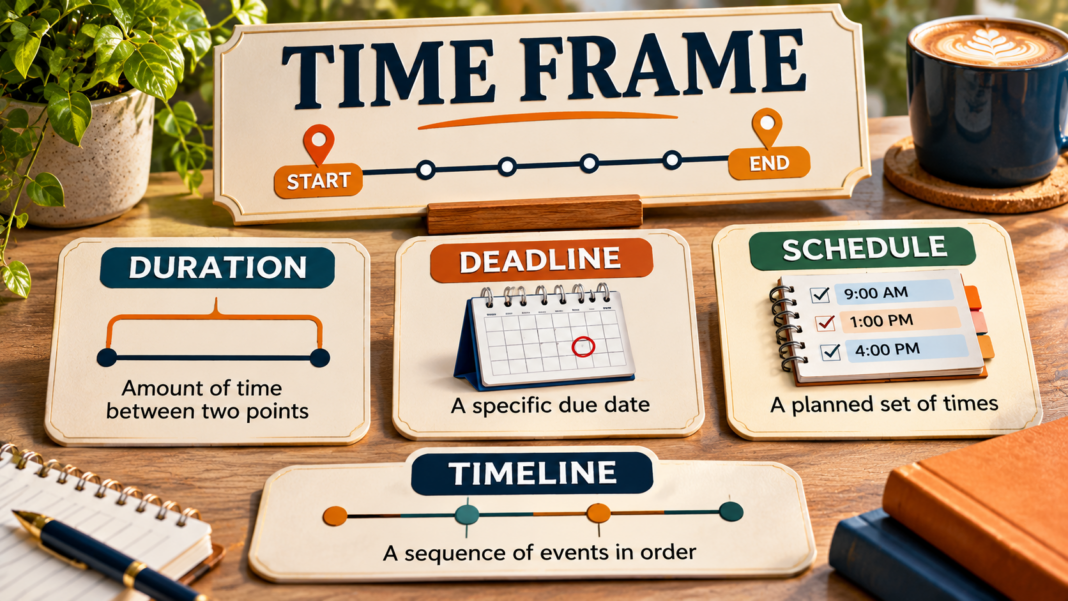
Time period, timeline, schedule, duration, and window are useful alternatives to time frame, but they do not always mean the same thing. Use deadline when you mean the final due date. Choose duration when you mean how long something lasts. Use timeline when you need to show the order of events.
That difference can change a work email. Asking for a project timeline invites a sequence of steps; asking for a deadline requests one final date. If you want clearer writing, choose the phrase that describes exactly what you need.
Find the Right Phrase Quickly
Start with the question behind your sentence. Is it about how much time is available, when an event happens, or when work must be complete?
| What you mean | Best alternatives | Example |
|---|---|---|
| A general span of time | Time period, period, span | We reviewed sales over a six-month period. |
| A plan with dates and steps | Timeline, schedule | Could you share the launch timeline? |
| How long a task takes | Duration, estimated completion time | What is the expected duration of the repair? |
| A final due date | Deadline, due date, target date | The application deadline is June 10. |
| A limited opportunity to act | Window, available period | The registration window closes Friday. |
| Time from request to delivery | Turnaround time, lead time | Our usual turnaround time is three business days. |
A word can be grammatically correct yet still give the wrong information. Deadline is not a direct replacement for duration because one marks an end point and the other measures elapsed time.
Alternatives That Describe a Period
1. Time period
Time period is a clear, general substitute when you mean a stretch of days, months, or years. It suits everyday writing and reports. The word period often works just as well without time.
Before: The survey covered a two-year time frame.
After: The survey covered a two-year period.
Choose this phrase when the exact start and end dates matter more than any steps inside the period.
2. Span
Span emphasizes length. It sounds natural in sentences about how long a change, career, or study lasted. A span can be brief or extensive.
Example: The company expanded its services over a three-year span.
A span does not usually tell the reader which tasks must happen on particular dates. Use it for length, not a detailed work plan.
3. Duration
Duration means the length of time something continues. It fits events, courses, repairs, experiments, and travel. A duration can be measured even when the calendar dates are unknown.
Example: The expected duration of the workshop is 90 minutes.
Do not replace time frame for completion with duration if the reader actually needs a due date. A three-day duration could start next week or next month.
4. Interval
Interval often refers to the space between two events or scheduled moments. It is especially useful in scientific writing, monitoring, and discussions of repeated actions.
Example: The system records a measurement at five-minute intervals.
In casual emails, period is usually friendlier. The technical sense of interval is more precise when the gap itself matters.
5. Window
Window suggests a limited chance to do something. It suits appointments, registration, deliveries, maintenance, and planned access.
Example: Customers can choose a delivery window between 2 p.m. and 5 p.m.
The phrase window of opportunity is broader and less specific. A delivery window should usually include actual hours, not just a vague estimate.
Words That Describe Plans and Dates
6. Timeline
A timeline shows events or project stages in order. It may include a start date, review meetings, milestones, and a launch date. Use it when someone needs the bigger picture instead of one isolated date.
Example: Please send the design timeline with the review and approval stages.
If you simply need to know when a file is due, deadline is shorter and more direct.
7. Schedule
A schedule sets out planned times for events or activities. It is natural for shifts, classes, meetings, deliveries, and recurring work.
Example: The team updated the training schedule after the holiday.
A schedule may change without changing the total duration of a project. It tells the reader when things are planned, not necessarily how long the whole effort will take.
8. Deadline
A deadline is the time or date by which something must be finished. It is stronger and narrower than time frame. A deadline does not describe all the time available before it. The Cambridge Dictionary definition of deadline makes that end-point meaning clear.
Example: The final deadline for submitting the proposal is Friday at noon.
If the date is optional or flexible, target date may be a better choice than deadline.
9. Target date
A target date gives people a planned finish date without always suggesting a firm contractual requirement. It is useful when teams are still estimating effort.
Example: Our target date for releasing the update is August 12.
Make the difference between a target and a commitment explicit. A client may read an unqualified target date as a promise.
10. Due date
A due date is the day an assignment, payment, form, or other item must be submitted or completed. It sounds natural in schools and administration.
Example: The invoice due date is the 15th of next month.
It is often clearer than time frame when a message concerns one submission rather than an ongoing process.
Terms for Delivery and Completion
11. Turnaround time
Turnaround time usually describes the time needed to complete a service or return a result after a request is received. Printers, laboratories, repair shops, and support teams use it often.
Example: The standard turnaround time for editing is four business days after we receive the final draft.
Notice the starting condition. Without it, a customer may not know when the clock begins.
12. Lead time
Lead time is useful in purchasing, manufacturing, and logistics. It describes the period between an order or request and the moment a product or service becomes available.
Example: The supplier requires a two-week lead time before shipment.
Lead time and turnaround time overlap in some workplaces, but they are not universal synonyms. A supplier may calculate lead time from order confirmation while a service provider may calculate turnaround time from receipt of all materials.
13. Estimated completion time
Use estimated completion time when the reader wants an approximate finish time, not the entire process. It works for help desks, repair requests, and project updates.
Example: The estimated completion time is 3 p.m. tomorrow.
If you mean a length of time instead of a clock time, estimated duration is safer: The repair should take about four hours.
Better Phrases in Real Emails
Professional messages sound more useful when they ask for a specific kind of time information. Compare these edits.
Project update
Vague: Can you share the time frame for the website redesign?
Clearer: Can you share the redesign timeline, including the review and launch dates?
Customer support
Vague: What is the time frame for a reply?
Clearer: What is your usual response time for this type of request?
Event planning
Vague: What time frame should guests arrive?
Clearer: What is the arrival window for guests?
A request that needs prompt attention is a different writing problem. If your message asks a colleague to act soon rather than explain a schedule, see our guide to alternatives to as soon as possible. It shows how urgency and politeness affect the wording.
Common Mix-Ups to Avoid
A schedule is not always a deadline. A schedule can contain several dates. A deadline refers to the final point when a task is due. Use both when necessary: The schedule lists the review sessions, and the final deadline is October 9.
A duration is not a target date. The course lasts six weeks answers how long. The course ends December 4 answers when. If someone asks when to expect a result, duration alone may leave them uncertain.
A delivery window is not a guaranteed arrival time. A two-hour window gives a range. A scheduled appointment at 10 a.m. names one time. Use the level of precision the sender can actually support.
Time frame and timeframe are both used. Cambridge lists time frame, timeframe, and time-frame as variants. The dictionary entry for time frame defines the term as a period within which an activity is intended to happen. In a document, pick one style and use it consistently.
Choose Precision Over a Longer Synonym
Replacing time frame with a fancier phrase will not improve a sentence unless the new wording makes the timing clearer. If the reader needs a date, give a date. If the reader needs a length, name the duration. If several steps matter, share a timeline or schedule. A specific sentence often works better than any synonym: We expect to finish by Thursday tells the reader much more than We expect to finish within the planned time frame.
