

A bad dad joke is a deliberately corny joke whose obvious punch line makes you groan before you laugh. The silliness is part of the appeal. A joke can be so predictable that the person telling it starts smiling before they reach the final word. If you’re looking for a few harmless jokes that might earn an eye roll, these original examples are ready for family dinners, school breaks, and awkward silences.
“I told my calendar a bad joke. It said the timing was terrible.”
Not every joke here needs a clever explanation. Often, the fun comes from recognizing the double meaning instantly and wondering why somebody felt the need to say it aloud.
Terrible one-liners worth repeating anyway
These jokes keep the setup short and the punch line painfully obvious. Read them with a straight face if you can.
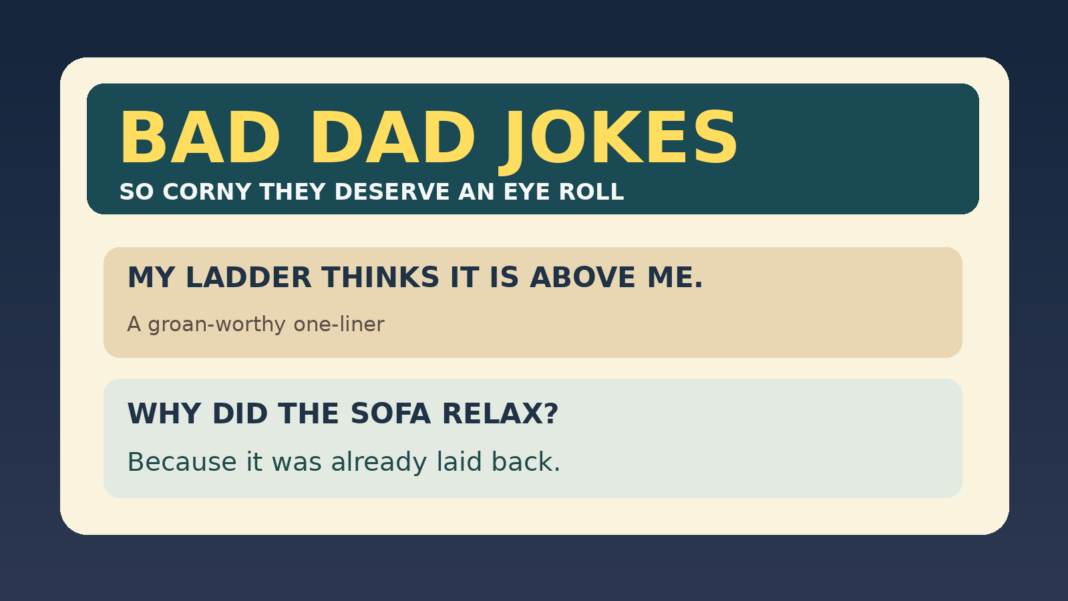
- “My ladder and I aren’t speaking. It thinks it’s above me.”
- “I bought a silent clock. It doesn’t have much to say for itself.”
- “I told the sofa to relax. It said it was already laid back.”
- “My pencil tried stand-up comedy. Its jokes had no point.”
- “I asked the refrigerator for advice. It told me to stay cool.”
- “The pillow lost the argument. It folded under pressure.”
- “I wanted to compliment the elevator, but it was already getting carried away.”
- “My garden hose has a flexible schedule.”
- “The measuring tape is never short on opinions.”
- “I lost my broom’s number. We just swept the problem aside.”
One-liners work best when the last few words provide the twist. “Stay cool” is good advice in an ordinary conversation, but a refrigerator makes the instruction literal. The joke doesn’t ask you to solve anything difficult. It invites you to notice an obvious connection and share the groan.
Question-and-answer jokes that make people sigh
A familiar question can make an intentionally bad joke even worse in the best way. Give someone a second to think before revealing a punch line that was hiding in plain sight.
Why did the notebook refuse to argue?
It didn’t want to make a scene on paper.
What did the chair say to the tired student?
“I’ve got your back.”
Why did the lamp fail its driving test?
It kept making light of the rules.
What did the garden gate tell the visitor?
“I’m open to suggestions.”
Why did the potato avoid the spotlight?
It didn’t want to become a hot topic.
Why did the blanket get invited everywhere?
It knew how to cover every occasion.
The questions are deliberately ordinary, which makes their silly answers more surprising. A blanket literally covers things, but “cover every occasion” can mean being prepared for all situations. That small shift between literal and figurative meaning is the heart of the joke.
Bad jokes about food and the kitchen
Food words have plenty of meanings beyond cooking. A baker can make dough and earn dough. A lemon can taste sour, and a person can feel sour after a disappointing day. These familiar expressions make easy material for groan-worthy humor.
- “My loaf of bread wants a raise. It needs more dough.”
- “I asked the onion for a story. It had too many layers.”
- “The peanut butter gave a long speech. It really spread itself thin.”
- “The cookie applied for a loan. Its credit was crumbling.”
- “I tried to argue with the pasta. It kept twisting my words.”
- “The soup was bad at keeping secrets. It always spilled the beans.”
- “My toast became a motivational speaker. It wanted everyone to rise.”
- “The lemon gave me a strange look. It seemed a little bitter.”
Food jokes can be useful with children because the objects are easy to picture. A listener who doesn’t know the idiom “spill the beans” may need to learn that it means revealing a secret. Once they know the expression, a bowl of soup spilling beans becomes funny in a different way.
Office and school jokes for brave audiences
These might not improve your reputation as the funniest person in the room, but they’re generally safe for a school lunch table or a casual workplace conversation.
- “The office printer requested vacation time. It was feeling jammed.”
- “My desk was promoted. It was outstanding at supporting projects.”
- “The math test and I have unresolved problems.”
- “The whiteboard couldn’t commit to the plan. Everything kept getting erased.”
- “I called a meeting about clocks. We ran out of time.”
- “My stapler is a loyal employee. It keeps things together.”
- “Our filing cabinet doesn’t gossip. It keeps everything on record.”
Timing matters more than volume. A quick joke after a task has ended can lift the mood; interrupting someone’s serious explanation with a pun may feel rude. Keep workplace humor about familiar objects or shared situations rather than a colleague’s appearance, background, or mistakes.
The difference between bad and mean jokes
A deliberately bad dad joke usually fails because its wordplay is too obvious, too corny, or mildly absurd. It does not need to embarrass a real person. A joke about a forgetful pencil is harmless because nobody is the target. A joke about someone’s disability or identity is a very different kind of humor, regardless of how its teller describes it.
That distinction helps explain why bad dad jokes travel so easily between generations. They often rely on ordinary language rather than references to personal events. Grandparents, parents, and children can understand the same joke if they know its double meaning.
The Cambridge Dictionary definition of a dad joke connects it with simple, often intentionally corny humor and puns. You do not have to be a parent to tell one. The term describes a style of delivery and joke construction, not the identity of the speaker.
How to deliver a truly awful punch line
First, avoid announcing that your joke is hilarious. A serious face often makes a ridiculous line funnier. Pause just before the final word, and don’t rush to explain it afterward. If the listener groans, accept that as a possible success.
Try this simple example: “My calendar has been feeling stressed.” Pause. “Its days are numbered.” The expression “days are numbered” commonly refers to limited time, but a calendar literally prints numbered days. The humor rests on both interpretations being available at once.
| Technique | Example |
|---|---|
| Double meaning | “My chair is very supportive.” |
| Literal expression | “My umbrella always covers for me.” |
| Human trait applied to an object | “My printer is having a bad day.” |
Of course, explaining the construction can make a joke feel even less funny. These explanations are for readers who want to understand or write their own wordplay. During a real conversation, a brief setup and a clean punch line are usually enough.
Write your own groan-worthy joke
Pick an everyday object such as a window, shoe, book, or lamp. List phrases associated with it. A window can be clear, open, or transparent. A shoe has a sole and a tongue. A book has chapters and a spine. Select a word that also appears in a phrase about human behavior.
- Object: a window.
- Related idea: seeing through something.
- Human expression: “I can see right through your excuse.”
- Joke: “The window didn’t believe my story. It could see right through it.”
The sentence is intentionally ridiculous because a window is treated like a person who can detect dishonesty. You can repeat this process with dozens of objects without copying a familiar punch line.
Read your result aloud. If the listener needs a paragraph of explanation, the connection may be too obscure. If the punch line is obvious a moment before you say it, you may have created exactly the type of bad joke you’re after.
When a bad dad joke actually works
An intentionally corny line can interrupt an awkward silence, open a casual conversation, or give a child an easy joke to remember. It also works in a birthday note when the recipient enjoys wordplay. The audience matters: somebody in distress may need sincere attention rather than another pun.
If you want a broader collection, our dad jokes guide includes more family-friendly jokes and explains the wordplay. This set focuses on the intentionally awful ones, the sort you tell knowing full well that someone will say, “Please stop.”
The response doesn’t have to be a big laugh. Sometimes a smile, an eye roll, or a second of silence tells you the joke landed exactly as badly as you intended.
