

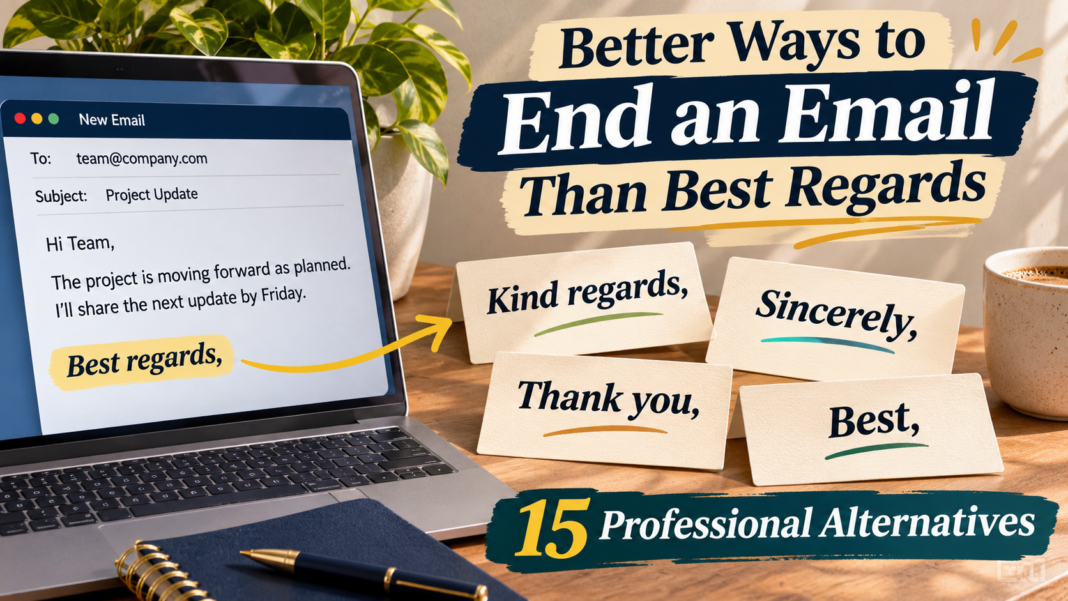
You have written a clear, thoughtful email. Then you reach the final line and type Best regards for the fifth time today. It is a perfectly good closing, but it is not your only option. Kind regards, Sincerely, Best, Thank you, and All the best can all replace it, depending on whom you are writing to and what you want your last line to convey.
The best choice is not always the fanciest phrase. A note to a hiring manager needs a different finish from a quick update to a teammate. Use the suggestions below to choose a sign-off that sounds natural in American English.
Pick a closing that fits the relationship
Best regards is a polite, versatile email sign-off. It communicates goodwill without sounding especially personal. You can use it with coworkers, clients, and contacts you know only through email. There is no need to replace it if it suits the message.
If you want a little more warmth, use Kind regards. If you want a shorter everyday close, try Best. For a formal application, Sincerely is a safe choice. When someone has helped you, Thank you can feel more specific than a general wish of goodwill.
Choose the tone first
Formal first contact → Sincerely,
Polite business relationship → Kind regards,
Everyday work update → Best,
Genuine thanks for someone’s help → With appreciation,
Professional alternatives worth keeping handy
1. Kind regards
This close keeps the respectful tone of Best regards but feels slightly warmer to many readers. It fits client notes, introductions, and emails to people you work with regularly. Example: “I’ve attached the revised proposal. Please let me know if you’d like any changes. Kind regards, Maya.”
2. Sincerely
Choose Sincerely when the message is formal, such as a job application, a complaint to an organization, or a letter to someone you have not met. It is conventional and clear, although it can sound stiff in a casual team chat. Example: “Thank you for considering my application. Sincerely, Jordan Lee.”
3. Best
A single word is often enough. Best feels brisk and professional in everyday workplace email, particularly when the recipient already knows you. It may seem too abrupt in a sensitive or highly formal letter, so consider the full message’s tone.
4. All the best
This sounds friendly without becoming too personal. It works after a pleasant meeting, an introduction, or a conversation that has reached a natural end. Example: “I enjoyed our conversation and hope the launch goes well. All the best, Alex.”
5. Regards
Regards is concise and neutral. Some people find it cooler than Best regards, especially when the email contains criticism or a difficult request. Use it for straightforward administrative messages, but avoid it when warmth would help.
6. Thank you
A thank-you sign-off fits messages in which the recipient has already given time, information, or assistance. It also works when you are politely acknowledging a response. If you are making a substantial new request, include a genuine sentence of thanks in the body rather than relying on the sign-off to do all the work.
7. With appreciation
This is a more deliberate expression of gratitude. It suits a colleague who solved a problem, a mentor who shared detailed feedback, or an organizer who helped with an event. Because it carries more emotion than Regards, save it for a situation where you truly appreciate a contribution.
8. Many thanks
Many thanks is upbeat and somewhat conversational. You might use it after a teammate sends the document you needed. In some workplaces, a repeated many thanks attached to urgent requests can sound automatic. Match it to a real reason to be grateful.
Warmer endings for familiar contacts
Once you know the person well, a less formal closing may sound more natural. These options can make an email friendlier without changing its substance.
9. Warm regards
Warm regards adds a personal touch to the conventional business sign-off. It can suit a supportive message, a holiday note, or a long-standing client relationship. It may sound out of place in a terse technical update.
10. Best wishes
This choice works when you want to wish someone success or happiness. Example: “Congratulations on the new role. Best wishes, Sam.” It is less natural at the end of a routine request for a spreadsheet.
11. Take care
Take care is gentle and informal. It can be appropriate when someone is ill, under stress, or simply a friend you contact by email. In a first message to a senior executive, a more neutral closing usually reads better.
12. Talk soon
Use this when you actually expect another conversation soon. It suggests an ongoing relationship, not a promise of a response. Example: “I’ll send the agenda before Thursday’s call. Talk soon, Riley.” If no call or exchange is planned, choose a less specific ending.
13. Cheers
Cheers is casual, upbeat, and common in some English-speaking workplaces. Its tone varies by location and team culture. In American business writing, it is safest with people whose own messages are similarly informal.
Closings for more specific situations
14. Respectfully
This is formal and restrained. It can fit official correspondence or a carefully worded disagreement. It may feel unusually solemn in an ordinary customer email. Do not treat it as a universal upgrade to Best regards.
15. Looking forward to speaking with you
This is more than a standard sign-off: it tells the reader what comes next. Use it when a meeting or conversation is planned. It can serve as a final sentence followed by your name, though pairing it with Best or another short sign-off often gives an email a cleaner finish.
See how the closing changes the email
Two messages can share nearly the same content but need different endings. The difference is the relationship and purpose, not a rule that one phrase is always superior.
Sincerely supports the first email’s formal introduction. Thanks fits the second because the writer and recipient already work together and the message is a routine request. Neither ending needs extra adjectives to sound professional.
Small details that make sign-offs work
In conventional American business email, capitalize the first word of the closing, place a comma after it, and put your name on the next line. Write Kind regards, rather than Kind Regards, in ordinary sentence-style capitalization. Both words are often capitalized in email signatures, but the simpler form matches standard correspondence style.
A sign-off is not the same thing as a final sentence. “Please send your comments by Friday” gives the reader an action. “Best regards” expresses courtesy. If your message needs a deadline or next step, put that information in a sentence before the sign-off.
Keep the signature proportionate. A name is enough for someone who knows you. A first email to a client, professor, or new professional contact may benefit from a role and a useful contact detail. Purdue University’s email etiquette guide recommends an appropriate sign-off and a signature block with the contact information the reader needs.
Also pay attention to the greeting. “Dear Dr. Patel” followed by “Cheers” may feel mismatched, just as “Hey!” followed by “Respectfully” can sound odd. The University of Waterloo’s workplace email guide groups sign-offs by formality, a useful reminder that closings should match the audience.
Three sign-offs to use with care
- Thanks in advance: It may imply that the reader has already agreed to help. A direct, polite request followed by Thank you for considering this often gives the person more room to respond.
- Yours faithfully: Common in some traditional British letter formats, but generally unnatural in routine American work email.
- Love: Appropriate for close personal relationships, not for ordinary client or workplace correspondence.
If you are unsure how a closing will land, reread the last two sentences of your email and imagine the recipient’s relationship with you. Choose Kind regards for a friendly but professional finish, Sincerely for formality, or Best for an everyday exchange. A well-matched closing should feel like the natural end of the message, not a separate performance.
