

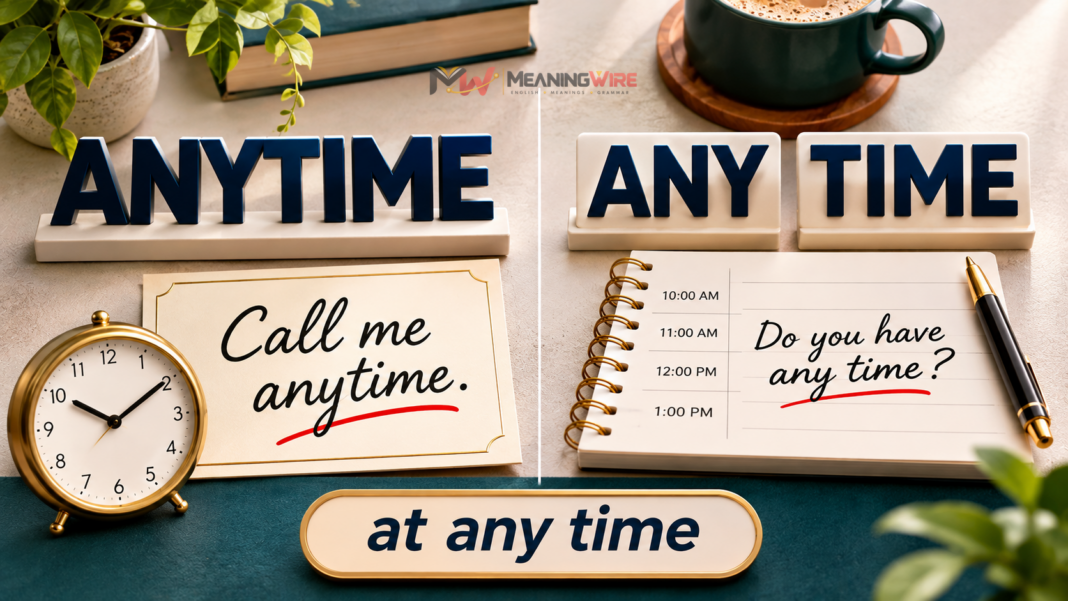
Use anytime when you mean “whenever,” and any time when you mean an amount of time or use it after a preposition. “Call me anytime” is correct, but “Call me at any time” needs two words. The choice depends on the job the words do in your sentence, not on whether the sentence sounds formal.
The quickest way to choose
Try this simple check: can you replace the expression with whenever or at any time without changing the message? In a sentence such as “You can stop by anytime,” the single-word adverb works. American English also allows “You can stop by any time,” so both spellings can be correct there.
If time refers to a period you have, need, or can spare, keep it separate. “I don’t have any time to talk” describes how much time is available. There is no one-word substitute in that sentence.
A three-question spelling check
- Is “at” directly before it? Write at any time.
- Does “time” mean a period or amount? Write any time.
- Does it mean “whenever”? Anytime is natural in American English. Any time may also work.
That third point is easy to miss. This is not a pair in which one spelling is always wrong. The two forms overlap in several common uses. Merriam-Webster’s usage guide recognizes the two-word form in adverbial sentences as well as the single-word adverb.
When anytime means whenever
Anytime is an adverb. It tells the reader when something may happen, often without setting a specific hour or date. You can use it with offers, invitations, plans, and expectations.
“Email me anytime this week” gives permission to email on any day or at any hour that fits the context. “The package could arrive anytime now” says it is expected soon, though the exact moment is unknown. “She won’t return anytime soon” says her return is not expected in the near future.
Cambridge Dictionary defines anytime as an adverb and includes expressions such as anytime now and anytime soon. Notice that these two expressions describe expectations, not permission. Context makes the difference.
Same phrase, two different situations
“You can visit anytime.” An open invitation.
“The rain could start anytime.” An uncertain start time.
The single-word form also appears before a clause: “Anytime the alarm sounds, leave through the nearest exit.” Here it means “whenever the alarm sounds.” The two-word form, “Any time the alarm sounds,” is also acceptable in that construction. Use the version that fits your style and keep it consistent within the same document.
When any time must stay separate
Think of any as a word that describes the noun time. You might need a little time, have no time, or offer someone more time. In these situations, you are referring to an amount or particular period, so the words stay separate.
“Do we have any time before the movie?” asks whether there is time available. “She didn’t spend any time on the introduction” describes the duration of an activity. “Is there any time on Friday that works for you?” asks about an available slot. Anytime would not fit any of those sentences.
The other firm rule involves prepositions. The phrase is at any time, never at anytime. The word at introduces a phrase whose object is the noun time.
| Write this | Not this | Reason |
|---|---|---|
| You may leave at any time. | You may leave at |
It follows “at.” |
| Do you have any time? | Do you have |
It means an amount of time. |
| Any time after lunch works. | The phrase names a suitable time. |
The last example is especially useful because it looks similar to “Stop by anytime after lunch.” In the first sentence, any time is the subject: a time after lunch works. In the second, anytime tells you when to stop by. Word position alone does not decide the spelling; grammar does.
Five messages worth checking twice
Everyday emails and text messages often contain these expressions. The edits below show mistakes that are easy to overlook and cases in which both forms are fine.
1. “Call me at anytime.”
Better: “Call me at any time.” The preposition at requires two words. You can also shorten the whole phrase to “Call me anytime.” That rewrite removes at and uses the adverb correctly.
2. “I don’t have anytime today.”
Better: “I don’t have any time today.” You are talking about available hours or minutes, not saying that an action can happen whenever you want.
3. “You can text any time.”
Also correct: “You can text anytime.” Here the expression describes when texting is allowed. The one-word form is common in American English, but the two-word form is also established. There is no need to correct the original sentence.
4. “Anytime you need advice, ask.”
Also correct: “Any time you need advice, ask.” Each version means “whenever you need advice.” Neither implies that the advice must be urgent. If you are choosing between other easily confused forms, our advice vs. advise guide covers which word fits the sentence.
5. “Anytime is a good time to start.”
Better: “Any time is a good time to start.” Here any time names the subject of the sentence. You are saying that any chosen moment would be suitable, not modifying a verb with an adverb.
Anytime soon and any time soon
“I don’t think prices will fall anytime soon” means a decrease is not expected in the near future. This expression is especially common in negative statements and questions. “Will he be home anytime soon?” asks whether a return is likely before long.
You may also see any time soon in the same role. Merriam-Webster records the spaced version in adverbial use. You do not have to treat it as a typo, although anytime soon is a familiar choice in modern American prose.
Anytime now works differently. It means something could happen very soon: “The results should arrive anytime now.” It does not indicate an open invitation or unlimited availability. Compare that with “You can call anytime,” where the action is allowed at an unspecified moment.
What should you say after thanks?
When someone says, “Thanks for your help,” a friendly response is “Any time!” It suggests you would gladly help again. The reply is short for an idea such as “You can ask me for help at any time.”
You may encounter “Anytime!” as a one-word casual reply too. If you want a conservative edited choice for the stand-alone response, Any time! is clear and widely recognized. This courtesy use is different from a full sentence in which anytime acts as an adverb.
The phrase may not fit every situation. If the person has just thanked you for a one-time favor, “You’re welcome” or “Glad I could help” may feel more natural. Choose the reply according to the relationship and what you actually mean.
Does British English use the space?
American English uses the one-word adverb anytime freely. British English often uses any time in places where Americans might choose one word. Cambridge lists the British two-word option alongside its entry for anytime. This is a spelling preference in some adverbial contexts, not a change to the basic meaning.
Neither variety permits you to join a noun phrase that refers to an amount of time. “I need any time I can get” still treats time as a noun. “At any time” also remains two words after its preposition.
Formal writing often favors the fully spelled phrase at any time for clarity. A workplace policy might say, “Employees may report a safety concern at any time.” A friend is more likely to write, “Call anytime.” Both are natural when used in the right setting.
Try choosing before you peek
Pick the form that fits each sentence. More than one answer can be correct when the expression means “whenever.”
- “We can review the notes ___ tomorrow.”
- “There isn’t ___ left before our bus departs.”
- “You may update your password at ___.”
- “___ the door opens, the dog runs outside.”
- “___ on Saturday is fine with me.”
Show the answers and reasons
1. Anytime or any time. It means whenever tomorrow.
2. Any time. The sentence refers to an amount of time.
3. Any time. The expression follows “at.”
4. Anytime or any time. Both can introduce a “whenever” clause.
5. Any time. The phrase names a suitable point on Saturday and serves as the subject.
One final test: If adding at would create “at anytime,” stop and separate the words. If you are describing hours you have or need, leave a space. Otherwise, when you mean “whenever,” either form may be acceptable, with anytime especially natural in American English.
