

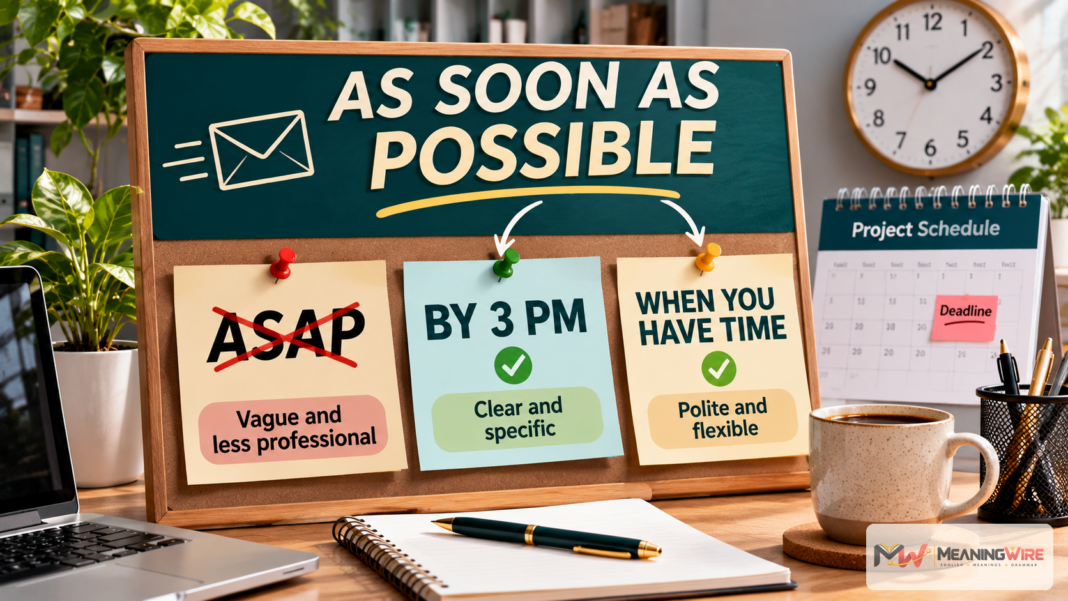
A message that ends with Please send this as soon as possible leaves one question unanswered: how soon is soon enough? If the report is needed by 3 p.m. then say so. If the task can wait until someone has time, a gentler request is better. Good alternatives include by the end of the day, when you have a chance, at your earliest convenience, promptly and as soon as you can. They do not all mean the same thing.
Choose your phrase based on the deadline and your relationship with the reader. A clear date often works better than another urgent-sounding expression. Below are practical replacements for emails, team chats and everyday requests.
Start with the actual deadline
As soon as possible means as quickly as the circumstances allow. The Cambridge Dictionary definition supports that meaning. It does not supply a precise time. One person may read it as within an hour. Another may read it as sometime tomorrow.
If a task has a real cutoff, the best replacement usually names it. Write Please send the figures by 2 p.m. Thursday when that is what you need. It respects the reader’s time because they can plan around a deadline they understand.
A clearer deadline in one edit
Please review this as soon as possible.
Could you review the draft by 3 p.m. Wednesday?
Now the reader knows exactly what to do and when to finish.
The deadline should be real. Do not invent a tight cutoff only to make a request sound more serious. If you need the work soon but cannot choose a time, explain the reason and ask whether a suitable deadline is realistic.
Gentle options without a strict deadline
These phrases give the other person more room. Use them when the request matters but does not require an immediate interruption.
At your earliest convenience
This is a polite and fairly formal request. It asks someone to act when a suitable opportunity arises. Could you send the signed form at your earliest convenience? works when there is no fixed deadline. It is not a good substitute for an emergency or a time-sensitive task. The reader may reasonably wait until their schedule allows.
When you have a chance
This sounds natural among coworkers and friends. When you have a chance, could you look over the second paragraph? suggests the request can fit around existing work. It may be too soft if a decision must happen before a scheduled meeting.
Whenever you’re able
Use this when flexibility is genuine. Send the photos whenever you’re able. It sounds considerate but may imply that timing is unimportant. Avoid it if you intend to follow up later the same day.
At a convenient time
This phrase works well for a call or meeting. Please let me know a convenient time to discuss the proposal. It is less useful when you require a completed deliverable. A meeting can be arranged. A report usually needs a clearer deadline.
All four options ask politely. None promises a quick response. If your project depends on a reply this week, include that detail rather than hoping your preferred pace is obvious.
Direct choices when time is short
Real urgency calls for language that is clear rather than dramatic. These alternatives have different levels of force.
By the end of the day
Could you send the revised slides by the end of the day? gives a specific day but may still leave room for confusion across time zones or different work hours. A clock time is safer when the deadline matters.
Within the next hour
This tells the reader how much time they have from the moment they receive the message. Please confirm the room number within the next hour. Use it only when an hour is a genuine requirement. People may not see an email immediately, so a clock time is more reliable for scheduled work.
Without delay
This is a firm expression for action that should begin immediately. Report any safety hazard without delay. It works in instructions and serious notices. It may sound harsh in a routine request for an update.
Immediately
Immediately leaves little room to pause. Leave the area immediately if the alarm sounds. Save it for an instruction that truly requires instant action. Most office emails do not.
Promptly
Promptly asks for reasonably quick action but does not set an exact cutoff. Please respond promptly to the customer complaint. It can sound formal or demanding depending on context. If you need a response today, say today.
Clear urgency also depends on the reason. A request to correct a public error before a launch is different from a request to tidy up an internal document next week. State the reason when it helps the other person prioritize.
Better phrases for professional emails
Here are practical rewrites you can adapt. The examples use fictional situations and should be adjusted to the actual deadline.
| Situation | Suggested wording |
|---|---|
| A firm deadline | Please send the final copy by Friday at noon. |
| A flexible review | Could you review this when you have a chance? |
| An urgent correction | Please correct the published date before today’s update. |
| A scheduling request | Let me know a convenient time to talk this week. |
| A reply needed soon | Could you confirm by 4 p.m. so we can finalize the plan? |
The final example explains why the reply matters. That makes the time request easier to understand. You do not need a long justification. A short reason can prevent unnecessary back-and-forth.
A considerate email also needs an appropriate closing. Our guide to alternatives to Best Regards shows how to finish a message without changing its intended tone.
Shorter alternatives for team chats
Slack-style messages and group texts often need less formality. You can write Can you check this today? or Could you send it before our call? without using a formal phrase at all. These versions tell the reader what matters.
Other natural options include As soon as you can and When you get a moment. The first suggests speed but recognizes the reader’s limits. The second gives them more flexibility. Do not treat the two phrases as interchangeable if your task is urgent.
You might also see ASAP in a short message. The Cambridge entry for ASAP confirms that it abbreviates as soon as possible. The abbreviation can sound abrupt in a request without context. Need the file ASAP communicates pressure but says little about the actual deadline.
Try Could you send the file before our 10 a.m. meeting? instead. A teammate can now tell whether the request fits their schedule. This is especially helpful when several tasks compete for attention.
Why polite can still sound demanding
Adding please does not erase an unreasonable deadline. Please do this immediately can still put someone under intense pressure. A helpful request gives a realistic timeframe and acknowledges the work involved.
Consider the difference between a five-minute approval and a detailed report. Both may be important. Yet the report usually takes more effort. If you need a quick answer first, split the request: Could you confirm receipt today? The full report can follow on Thursday.
At your earliest convenience can also frustrate people when you secretly expect an immediate response. Say what you mean. A soft phrase is not a substitute for a clear deadline. Good workplace communication balances courtesy with useful instructions.
What to say in a follow-up
When a request has gone unanswered, repeating ASAP may make it feel more forceful without making it clearer. A better follow-up mentions the earlier message and states the next action.
A polite follow-up example
Hi Jordan,
I wanted to follow up on the draft I sent Monday. Could you share your comments by Thursday afternoon? We plan to finalize the article on Friday.
If you need more time, please let me know.
Thanks,
Alex
This sample gives a reason and leaves room for a realistic reply. In a highly urgent case, you may need to call or use the normal escalation channel instead of sending another email. The right communication channel can matter as much as the words.
If you are unsure whether to write please advise in a follow-up, our advice vs. advise guide covers the verb and noun forms. Clear grammar helps a request sound professional but it cannot replace a real deadline.
Phrases that look similar but differ
Some alternatives describe speed. Others describe priority. The distinction is useful when you choose language for work requests.
- As a priority asks the recipient to place a task ahead of less urgent work. It does not give a completion time.
- At the first opportunity means when a suitable chance arises. The opportunity could come later than you expect.
- At once calls for immediate action and may sound like an order.
- In a timely manner is formal but vague unless a policy or schedule defines what counts as timely.
A message can use priority and a deadline together. Please treat the correction as a priority and send the updated link by noon. The first part signals importance. The second tells the reader when you need the result.
One phrase cannot cover every case. Choose a firm instruction for a safety matter. Use a clear date for a project handoff. Offer flexibility when you genuinely have it.
Choose the right rewrite
Imagine that you need a coworker to review a draft. Which option fits each situation?
- The draft must be approved before a meeting at 11 a.m. tomorrow.
- The draft can wait until the coworker has a free moment.
- A visible error needs correction right now.
- You want a reply this week but have no fixed cutoff.
See possible answers
1. Could you approve the draft before our 11 a.m. meeting tomorrow?
2. Could you take a look when you have a chance?
3. Please correct the visible error immediately.
4. Could you share your feedback by the end of this week?
The goal is not to avoid as soon as possible completely. Sometimes it is the right phrase because the earliest practical moment is what matters. Use it when flexibility is real. If you know the time you need the work, name it directly.
