

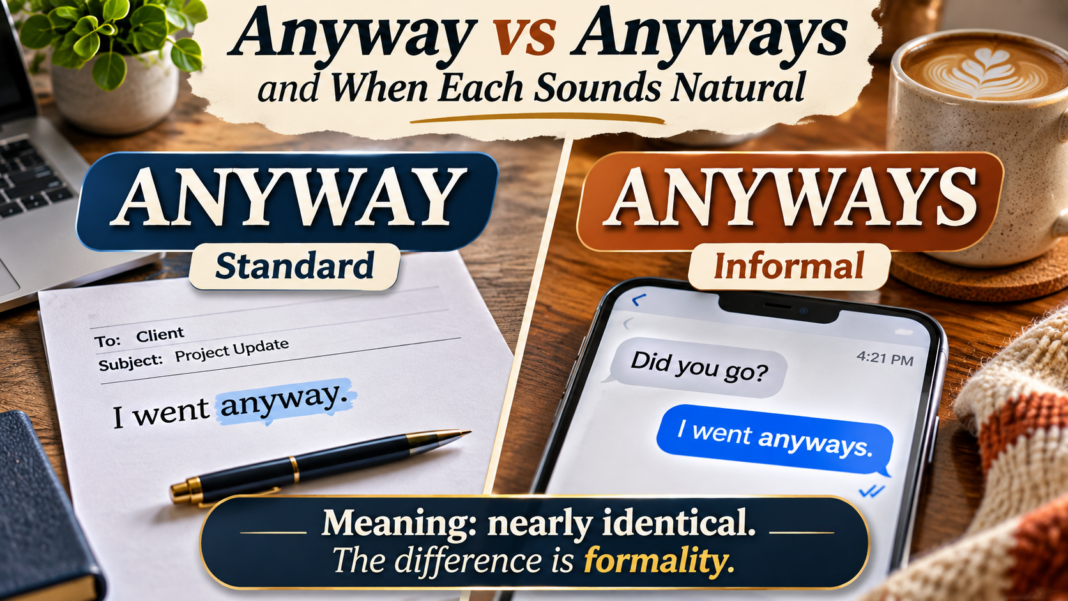
Anyway is the safest choice in almost every situation. Anyways means much the same thing, but it sounds more casual and is especially associated with informal American speech. Neither word is a plural noun. The extra s changes the tone and the level of formality, not the basic message.
If you are writing an email to a professor, a work report or a school assignment, choose anyway. If you are chatting with a friend, anyways may sound perfectly natural. You can also use anyway in casual conversation without sounding stiff.
Two versions with different tones
Dictionaries recognize anyways as a real word. The Cambridge Dictionary entry for anyways labels it an informal US form of anyway. The Oxford Advanced American Dictionary also lists anyways as an informal alternative. That is why calling it a nonexistent word is misleading.
One thought, two tones
Neutral: The meeting was canceled, but I went to campus anyway.
Casual: The meeting got canceled, but I went to campus anyways.
The second sentence is not hard to understand. Its choice of word simply makes it sound more conversational. In an edited article, the first version is a better fit. This is a question of register, which means the style of language that suits a particular audience.
Three useful jobs for anyway
Anyway does more than end a sentence. It can express a decision despite a problem, move a conversation to another subject or limit a claim. The position of the word often tells you which meaning is intended.
Doing something despite a problem
In this use, anyway is close to regardless or even so. A difficulty exists, but it does not change the result.
The forecast looked terrible. We took the trip anyway.
She knew the application was late, but she submitted it anyway.
Both examples tell you that the action happened despite a reason to avoid it. Placing anyway at the end feels natural because the previous part of the sentence explains the obstacle.
Getting back to the point
At the start of a sentence, anyway can move the conversation forward. A person might use it after a long side story or to return to an interrupted topic.
Anyway, did you get the address I sent?
Anyway, back to the plan for Saturday.
Here the word does not mean that someone acted despite a problem. It marks a change in the conversation. A text that opens with anyways can do a similar job, though it carries a more relaxed voice.
Adding a reason or narrowing a claim
You can use anyway to add a practical reason that supports what you have just said.
We should take the train. Parking is expensive anyway.
It can also soften or qualify a statement: The store closes at nine, on weekdays anyway. The speaker is certain about weekdays but has not made the same promise about weekends. In this situation the word is closer to at least.
These meanings explain why anyway appears in so many kinds of sentences. It is not merely a filler word, although speakers sometimes use it when they need to restart a thought.
How anyways sounds in conversation
In casual American speech, anyways often appears as a friendly reset after a tangent: Anyways, what time are you coming over? It can also end a sentence: I already bought the tickets anyways. In both cases, anyway would work too.
People sometimes use anyways to make a comment sound playful, dismissive or slightly impatient. Imagine a friend gives a long excuse and you reply, Anyways, are we going or not? The word signals that you want to move on. But tone comes from the whole message, not from the final letter alone. The same sentence with anyway could sound impatient as well.
A more polite message might skip either word: Could we get back to the original question? When a conversation is tense, replacing a transition with a direct, considerate sentence can prevent the reader from feeling brushed aside.
Choosing words for school and work
Formal and professional writing usually calls for anyway. An essay, cover letter or workplace update should not depend on a conversational spelling to sound natural. In a research paper you might write: The sample was small, but the team reported the result anyway. That version keeps the focus on what happened.
Business emails require a little more judgment. Anyway, here is the revised file is grammatically fine, but it can suggest that you are abruptly changing the subject. If the reader does not need that signal, I have attached the revised file is clearer. The best edit may be to remove the transition rather than choose between the two spellings.
The same applies to the end of an email. Tone depends on the message and the sign-off, not on one adverb. If you want a more suitable closing phrase, see our guide to professional alternatives to Best Regards.
Creative dialogue is different. A novelist may use anyways to preserve a character’s voice. A transcript may retain it because the person actually said it. Editors should distinguish a deliberate informal choice from an accidental mismatch with the publication’s style.
Do not confuse anyway with any way
There is a third form that changes the meaning more noticeably: any way with a space. It combines the determiner any and the noun way. It refers to a method, manner, route or possible option.
Compare the meaning
I’ll help anyway. The help will happen regardless of a possible obstacle.
I’ll help in any way I can. The person is willing to help through whatever methods are available.
Is there any way to fix this? The question asks whether a possible method exists.
A simple test is to try adding a describing word before way. If any practical way or any other way makes sense, the two-word phrase is likely what you need. In I went anyway, adding such a word does not work because anyway is functioning as an adverb.
This difference is about grammar, not just spelling. Another useful comparison is anytime versus any time, where a single word and a two-word phrase can also serve different purposes.
Where a comma actually belongs
A sentence that begins with Anyway often uses a comma after the word because it introduces a shift in the conversation: Anyway, we found a better route. This punctuation helps readers hear the pause.
When the word sits naturally at the end of a statement, you usually do not need a comma directly before it: We stayed anyway. A comma can appear when the writer deliberately sets the word apart as an afterthought, but it is not automatic.
Mid-sentence uses depend on the structure and the intended pause. Compare I don’t need another jacket, and anyway, this one is too expensive with I wanted to leave, but I stayed anyway. The punctuation follows the job of the expression. It does not change simply because you choose the informal variant.
Quick edits that sound more natural
Look at these revisions as tone choices instead of a list of forbidden words.
- Anyways, your request has been approved. In a formal response, use Your request has been approved. The transition adds nothing.
- I did it anyways. In ordinary edited prose, use I did it anyway. The meaning stays the same.
- Contact us anyway you prefer. If you mean the method of contact, write Contact us any way you prefer. The space matters.
- Anyway I can help? If you mean to ask about possible methods, write Is there any way I can help?
The last two corrections are especially important. Unlike the choice between anyway and anyways, they fix a difference in grammatical structure.
If you are uncertain, ask two questions before you send the sentence. Are you expressing regardless or moving the conversation forward? Use anyway, or anyways only if an informal voice is appropriate. Are you referring to a possible method or route? Write any way as two words. That small check handles most everyday cases without treating normal speech as an error.
