

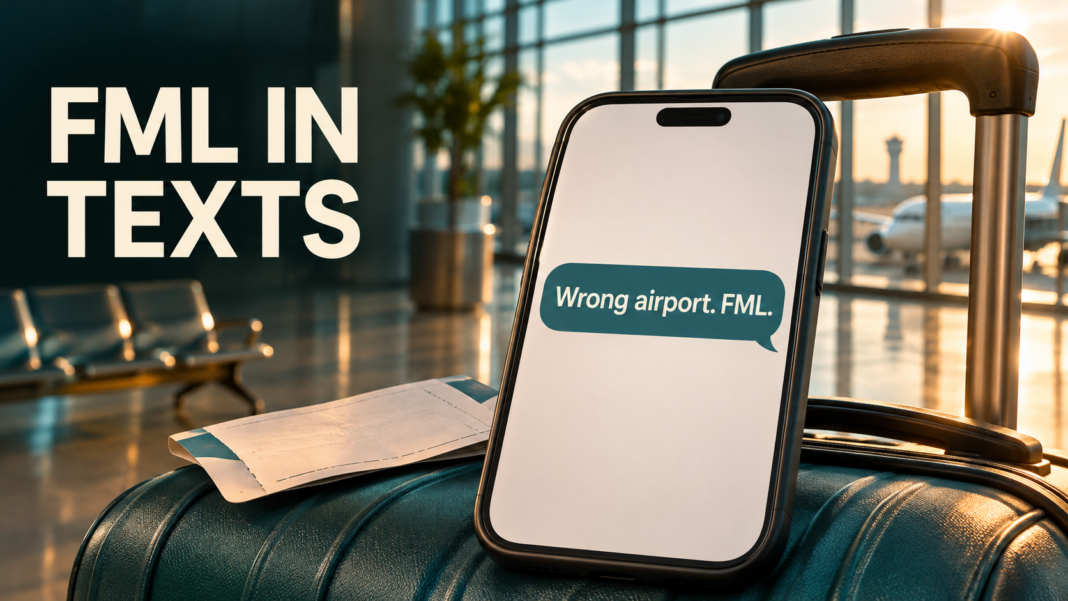
You reach the airport with time to spare. Then you check your ticket and realize you went to the wrong airport. If you text a friend FML in that moment, you’re saying fuck my life. It’s a blunt reaction to bad luck or a mistake. It can sound funny after a small mishap or much heavier after genuinely bad news. See the Collins English Dictionary entry for FML.
At the airport
Maya: Made it to the gate early. It’s the wrong airport. FML.
Chris: Oh no. What time does your flight leave?
Chris doesn’t need to use slang back. His question works because Maya has a problem to solve and a clock to beat. A joke might work after she finds a new flight. Right now she needs to know whether there’s time to get across town.
Read the message before the letters
FML often lands at the end of a message. The sender gives you the bad news first and then adds their reaction. Think of a friend who texts: I brought my lunch to work. Left it on the bus. FML. The last three letters are the sigh at the end of the story.
At the start of a message, FML can tell you something went wrong before you know what happened. You hear the reaction first and find out why a second later.
FML. I sent the attachment to the wrong Alex.
A message that contains only fml gives you even less to work with. What happened? is a natural reply when you don’t have the backstory. Lowercase fml has the same meaning as uppercase FML. Capitals can make the reaction look louder. They can also be how that person types every abbreviation. Put more weight on the actual situation than on the size of the letters.
Match your reply to the situation
A friend who spills coffee on their shirt ten minutes before a meeting may appreciate a joke. A friend who just got an unexpected bill may want to talk. Either person could send the same three letters. What happened before they hit send tells you more about how to answer.
| What they texted | A reply that fits |
|---|---|
| My toast landed jam-side down. FML. | Of course it picked that side. |
| I left my keys at your place. FML. | I’m still home. Want me to bring them over? |
| My shift got canceled again. FML. | That’s rough. Want to talk about it? |
| fml | What happened? |
Pick a reply you can follow through on. An offer to bring the keys helps if you have time to make the trip. If you don’t, tell your friend where they can pick them up. A direct question also helps when someone sounds more upset than usual. Ask whether they want advice or just need to vent. It gives them a way to say what would help.
You can also acknowledge a problem before you offer a fix. Say your friend tells you their car won’t start again. A reply like That’s the second time this week. Do you need a ride? shows that you heard what happened and gives them an easy question to answer.
When the joke is on the sender
Picture a group chat where someone posts a photo of a bookshelf they spent an hour assembling. The shelves look fine. The instruction booklet in the corner says to put the back panel in before the last shelf. Their caption reads: Guess which step I skipped. FML.
The humor comes from the gap between the big reaction and the ordinary mistake. A friend could send back a joke about the bookshelf because the sender already sees the funny side. That reply could land badly if the person had just broken something they couldn’t afford to replace.
In public comments you have less context. FML this happens to me every time may be someone recognizing their own bad habit in a video. A private text about a difficult day gives you a different cue. If a public comment uses TS to point back to the video or the situation, read the rest of the line before you settle on what it means. See how context changes the meaning of TS.
Say what went wrong at work
FML still contains profanity even when it’s shortened. Close friends may barely notice it. In a team channel or a message to someone you’ve just met, it can sound stronger than you intend. A clear description also gives the other person something to act on.
To a friend: I attached the old menu to the event email. FML.
To the team: I sent the old menu with the event email. I’ll send the corrected version now.
The work version tells people what went wrong and what happens next. If you’re still waiting on a fix, give the next step you can promise. In a casual message where you want a cleaner reaction, I can’t catch a break keeps the frustrated tone.
How FML differs from ICL and SMH
FML reacts to something that went wrong. ICL introduces something the sender wants to say honestly. Imagine one person texts about a lockout and ends with FML. Their roommate replies that they honestly thought there was a spare outside and starts with ICL. One person vents. The other admits what they assumed. Read how ICL changes the tone of a text.
SMH can express disapproval or disbelief. Imagine two people see the same elevator go out of service. The person who lives on the eighth floor might text Elevator’s out again. FML. A neighbor who’s fed up with the repeated breakdowns might write SMH. They just fixed it last week. FML draws attention to the sender’s bad luck. SMH draws attention to what they find ridiculous. See other ways people use SMH in texts.
When it’s your turn to text
FML works best when the other person already knows enough to understand your reaction. If your roommate knows you’ve been trying to catch the last bus, Missed it by ten seconds. FML tells the whole story. If you need a ride, add the request. I missed the last bus. Can you pick me up at the library? gives them enough information to help.
