

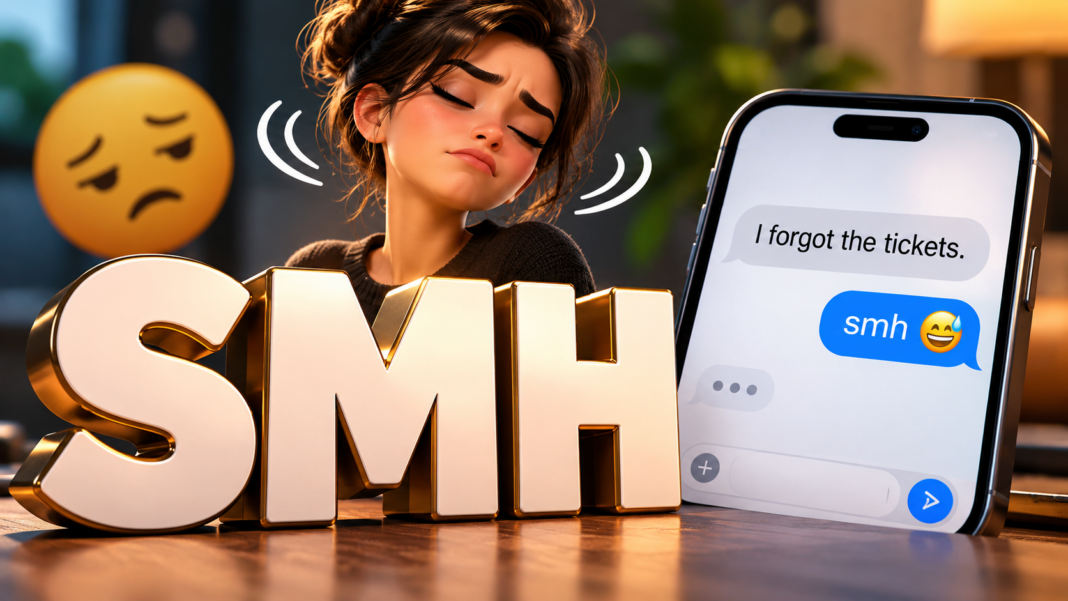
SMH means “shaking my head.” People use it in texts, comments, and social posts when something seems disappointing, ridiculous, frustrating, or hard to believe. If a friend says, “He forgot his own birthday party, smh,” the final three letters add a reaction: seriously, how did that happen?
Those letters are short, but their tone changes with the conversation. An amused smh between friends may be playful. The same reply to someone’s serious mistake can sound judgmental. The useful question is not only what the letters stand for, but what the person is reacting to.
The gesture behind the three letters
Imagine someone slowly moving their head from side to side after hearing an unbelievable excuse. That gesture is the idea behind SMH. It usually communicates disapproval or disbelief without spelling out a whole sentence.
The Cambridge Dictionary definition of SMH connects the abbreviation with situations in which someone does not believe or approve of something. It is an initialism: people typically say its letters, S-M-H, rather than pronounce it as one word.
AN ILLUSTRATIVE TEXT EXCHANGE
Alex: I left the tickets on the kitchen counter.
Jordan: smh, we checked twice 😭
Here, “smh” signals disbelief and frustration. The emoji may soften the reply, depending on their relationship.
Four reactions SMH can communicate
Disappointment
“They promised they would show up, then canceled again. SMH.” The speaker expected better behavior and feels let down. There is no need to imagine a literal head movement. The abbreviation carries the reaction on its own.
Disbelief
“You put the empty milk carton back in the fridge? smh.” Here the sender cannot quite believe what happened. It is close to saying “Seriously?” or “I can’t believe that.” Whether the reply is teasing or annoyed depends on the relationship.
Frustration
“The app crashed right before I saved everything, smh.” In this example the writer is irritated by an event, not necessarily blaming another person. That matters: SMH does not always mean that someone is being insulted.
Playful embarrassment
“I waved back at someone who was waving at the person behind me. smh.” A person can use SMH about their own mistake. This version often feels self-aware and funny rather than angry.
Where SMH sits in a sentence
SMH can stand alone as a complete reaction. Someone might send “smh” after a surprising message, with no other words. It can also open or close a sentence. At the beginning, it prepares readers for an annoyed observation. At the end, it comments on what they just read.
BEFORE THE COMMENT
“SMH, the store closed early again.”
AFTER THE COMMENT
“The store closed early again, smh.”
ON ITS OWN
“smh”
Uppercase SMH and lowercase smh generally carry the same expansion. Lowercase can look more casual or understated in a chat, but there is no reliable universal rule that capitals always mean stronger anger. Read the rest of the message before interpreting the emotion.
Does an SMH reply mean someone is mad?
Not necessarily. SMH often expresses a negative reaction, but negative does not always equal serious anger. Imagine two friends joking about a failed cooking experiment. One sends a photo of burnt toast, and the other says “smh 😂.” They may be laughing together. In a tense argument, a bare “smh” may instead sound dismissive.
Pay attention to three clues: the event being discussed, the closeness of the people involved, and any words that surround the abbreviation. “smh, you always do this” can feel sharper than “smh I did it again.” A single three-letter response to a vulnerable confession can also seem unsympathetic, even when the sender did not intend that.
When the message is important, ordinary words are safer. “That sounds frustrating” offers support. “I’m disappointed we missed the deadline” states a concern clearly. SMH is convenient, but convenience does not remove the possibility of misunderstanding.
How to respond when someone texts SMH
A useful response depends on whether the sender is reacting to you, a shared inconvenience, or a funny story. If you both see the same absurd situation, “I know, right?” or “That was ridiculous” may feel natural. When you made the mistake, “You’re right, I forgot” acknowledges it without escalating the conversation.
If you cannot identify the reason, ask directly: “Wait, what happened?” or “Are you upset about something I said?” Those replies are clearer than assuming the person is angry. You do not have to answer every SMH with another abbreviation.
Sometimes the sender uses it as a closing reaction rather than an invitation to debate. For example, after a complaint about a delayed bus, “smh” may simply finish the thought. A sympathetic “That’s annoying” is often enough.
SMH versus other common reactions
Different texting shortcuts describe different responses. ISTG means “I swear to God” and often adds emphasis to a claim. SMH communicates a reaction of disbelief or disapproval. A friend might write “ISTG, I sent the email yesterday,” and another could reply “smh, it never arrived.” The first person emphasizes what they say happened; the second reacts to the problem.
LOL generally points toward laughter, although it can also soften a sentence. SMH usually centers on disappointment, irritation, or disbelief, even when someone uses it humorously. A facepalm emoji can express a similar sense of embarrassment or exasperation, but gestures and symbols do not have perfectly identical meanings in every conversation.
You may also encounter SMDH, a stronger and less polite version that expands to “shaking my damn head.” Dictionary.com’s slang entry documents this form alongside other variations. Use it carefully because the added word makes the tone more emphatic.
Can SMH have another meaning?
In an ordinary text conversation, “shaking my head” is the safest default interpretation. Some sources also record rarer readings, including “scratching my head” for confusion and “so much hate.” Those alternatives exist, but it would be misleading to treat them as equally likely in a typical chat.
Context can change everything outside casual messaging. SMH can also be an abbreviation for a newspaper or another proper name in a completely different setting. A headline about Australian media, for example, may refer to The Sydney Morning Herald, not someone’s emotional reaction.
A simple check helps: if SMH follows a surprising mistake, complaint, or questionable comment, it almost certainly signals someone figuratively shaking their head. If the surrounding sentence names an organization, financial ticker, or publication, look for that specific meaning instead.
When you should skip SMH
SMH fits personal messages, group chats, comments, and informal social posts. It usually does not fit a job application, research paper, professional complaint, or formal customer response. In those settings, explain the specific problem rather than leaving readers to interpret a reaction.
It is also worth avoiding SMH when a friend shares a genuine loss or asks for support. A brief reaction can seem cold. “I’m sorry that happened” or “Do you want to talk about it?” communicates care more reliably.
In everyday chats, though, SMH is useful precisely because it conveys a familiar gesture without a long explanation. Treat it as a signal about tone, not a substitute for understanding the situation. The same “smh” can be light teasing in one conversation and real disappointment in another.

[…] abbreviations do different jobs. SMH usually expresses disapproval or disbelief; it does not mean the sender is promising honesty. ISTG […]