

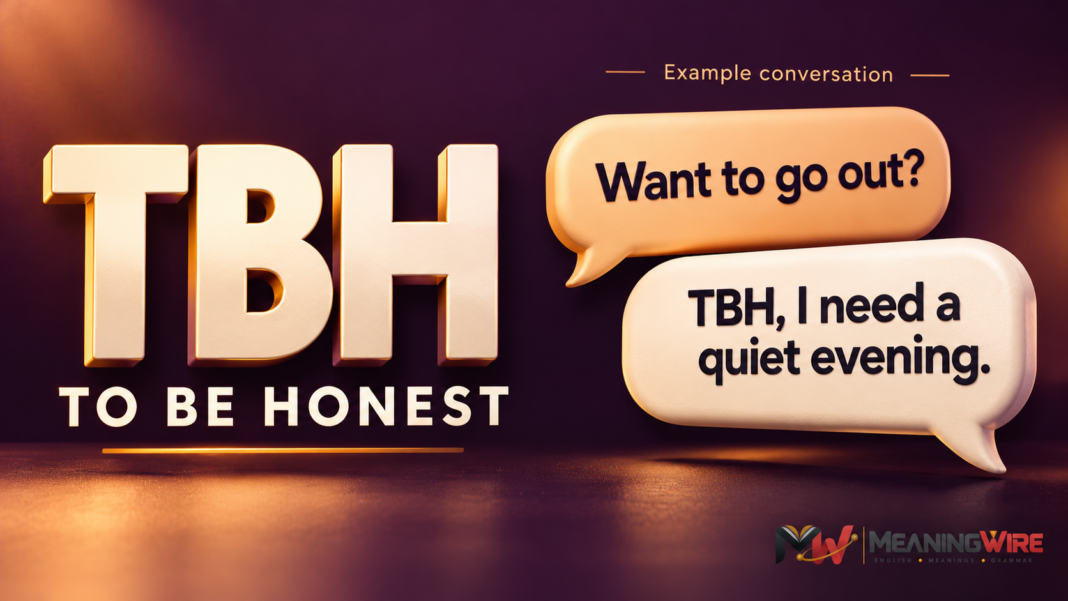
TBH means “to be honest” in text messages. A friend who writes “tbh, I would rather stay home” is introducing a candid preference. The letters do not automatically signal an insult, a confession, or flirting. Read the opinion that follows them before deciding how the message feels.
Three letters that frame an opinion
TBH tells you how the sender wants you to take a statement: as an honest thought. Oxford Learner’s Dictionaries labels the abbreviation informal and gives the expansion to be honest. Its pronunciation is the three letter names, “tee bee aitch.” You can also simply say the full phrase when reading a message aloud.
Both TBH and tbh have the same basic meaning. Lowercase fits casual typing; capitals make the abbreviation stand out. Capitalization alone does not establish that someone is angry. Compare the sender’s other messages and the rest of this one.
Notice that TBH frames an opinion without proving it. “TBH, that restaurant is terrible” remains one person’s judgment. The abbreviation does not turn a personal impression into a fact, and it does not necessarily imply that everything the person said earlier was dishonest.
Watch what happens after TBH
The following conversations are invented examples. Each uses the same abbreviation, but the speaker’s purpose changes.
Illustrative conversation
Maya: Want to go out tonight?
Eli: Tbh, I need a quiet evening.
Eli is explaining a preference, not rejecting Maya as a person. A useful reply would address the plan: “No problem. Another day?” Treating TBH itself as a warning sign would distract from what Eli actually said.
A compliment works just as naturally: “TBH, your presentation made the whole topic easier to understand.” Here the abbreviation emphasizes sincere praise. An admission could be “I haven’t finished the book, tbh.” That speaker acknowledges something they might feel awkward admitting. Neither sentence is an insult.
Disagreement can sound sharper: “Tbh, I don’t think that plan will work.” The sender may intend straightforward feedback, but a reader may still find it abrupt. The specific criticism, the relationship, and the surrounding discussion matter more than the three letters.
Is the message rude or flirty?
TBH is not a rude word by itself. It can introduce an unkind remark, a thoughtful explanation, or a warm compliment. “Tbh, you never listen” criticizes the recipient broadly. “Tbh, I felt ignored when I was interrupted” describes a particular experience. The second version gives the other person more information to respond to.
Adding TBH does not excuse a hurtful comment. If you are writing feedback, check whether the sentence names a specific issue and whether the recipient asked for your opinion. “The instructions were hard to follow” is more useful than “Your work is bad,” with or without the abbreviation.
Likewise, “tbh, you’re fun to talk to” might be friendly or flirtatious. It expresses a positive opinion, but it does not establish romantic interest. Look for clearer statements rather than treating one abbreviation as evidence of somebody’s intentions. A reply such as “I enjoy talking to you too” acknowledges the compliment without assuming more.
Short messages lack facial expression and vocal tone. If the meaning matters, ask about the statement itself: “Do you mean the timing won’t work, or the whole idea?” That question is more precise than asking why the sender used TBH.
“Give me a TBH” asks for something different
Sometimes TBH appears as a thing someone can give: “Give me a tbh” or “Like for a tbh.” In that social-media use, it usually means an honest opinion about a person. A response might describe what someone appreciates about them or their first impression.
Dictionary.com’s explanation of the TBH social-media prompt, published in 2018, documents this noun-like use and its connection to posts inviting personal feedback. That is evidence of an established usage, not proof that the prompt is currently popular on every platform.
Compare “Tbh, you helped me feel welcome” with “Send me a tbh.” The first introduces an opinion. The second requests one. The core connection to honesty remains, but the sentence gives the abbreviation a different job.
You do not have to participate in public judgments or rating games. “I’d rather keep that private” is a complete response. If you do participate, a specific, kind observation is clearer than a vague score or an assumption about somebody’s private life.
Reply to the thought, not the abbreviation
There is no required reply to TBH. Choose your response according to what the other person has said. These original examples show several different needs:
| Message | Possible reply |
|---|---|
| Tbh, I’m nervous about tomorrow. | What part is worrying you? |
| Your notes really helped, tbh. | I’m glad they were useful! |
| Tbh, I disagree with that choice. | Which part would you change? |
| Tbh, I don’t want to discuss it. | Understood. We can leave it there. |
A bare “tbh?” is harder to interpret. Depending on the previous message, the sender might want an honest answer or an opinion about themselves. “Do you mean my honest opinion about the plan?” checks the intended subject without guessing.
Other abbreviations perform different conversational jobs. HMU invites someone to get in touch, whereas TBH frames what someone thinks. A message can contain both, but they do not ask for the same response. Similarly, GTG depends on whether someone means gotta go or good to go; the surrounding conversation supplies the clue.
Write it where the honest thought is clear
TBH can introduce a sentence or follow it: “TBH, I prefer the smaller room” and “I prefer the smaller room, TBH.” In polished informal writing, a comma helps separate the phrase from the main statement. Friends often omit punctuation in texts, but that typing habit does not change the expansion.
Do not use TBH as a substitute for the whole opinion when your reader needs an answer. “TBH” alone after “Did you enjoy it?” leaves the actual response unfinished. Write what you mean: “Tbh, I liked the music more than the story.”
For a formal email, application, or report, a direct sentence is usually clearer. Instead of “TBH, the delivery date is unrealistic,” explain the issue: “The delivery date leaves only one day for testing.” You have preserved the concern and supplied a reason. In a friendly chat, “Tbh, I need another day” may be entirely appropriate. Choose the wording for the reader and the situation.
