

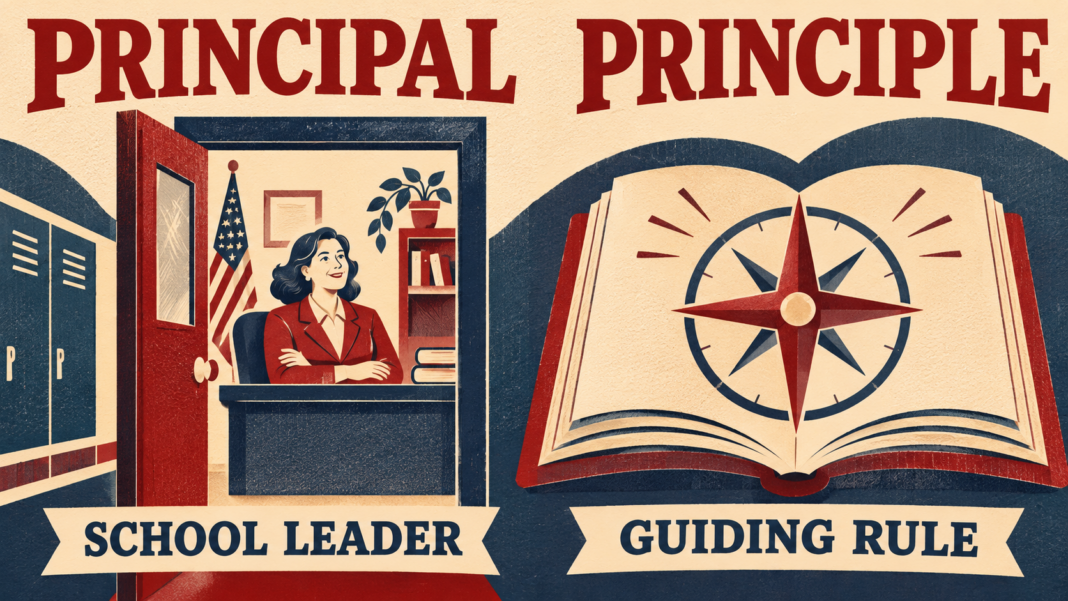
The school principal made the decision. A school principle explains the belief behind it. Use principal for the head of a school, the main person or thing, or the amount of money a borrower still owes before interest and fees. Use principle for a rule, belief or basic idea that guides how something works. The two words sound alike, so the job each word does in the sentence matters more than how it sounds.
Can You Replace It With Main?
Try swapping in main when the word describes a reason, goal or person. In The principal reason we moved the event was the heat, the phrase main reason says the same thing. The reason may sit alongside other reasons, such as the cost of renting equipment. Principal tells the reader which one mattered most.
The same test works in principal investigator. That title identifies the lead researcher on a project. It also works in principal concern and principal speaker. The noun after principal tells you whether the sentence refers to a worry, a person or something else. If you want a less formal choice for a report or email, try one of these alternatives for important and check whether it still conveys the right degree of importance.
The swap works in one direction. Main rule and basic principle may point to the same idea, but the words do different jobs. In the principal rule, principal describes rule. In the guiding principle, principle is the thing being described. You can even say the principal principle if you mean the most important principle. Most readers will find the central principle easier to read.
When Principal Names Someone or Something
In The principal met with the new teachers, the word names a person. You could replace it with the head of the school. Outside education, principal can also name someone in a leading role. An orchestra may call the lead player of a section its principal. A school can have more than one principal across its campuses, and the plural is principals.
Money is the other common use. Suppose you borrow $1,000. At the start, the loan principal is $1,000. If $150 of a later payment goes toward principal, the principal falls to $850 in this simple example. A separate $20 interest charge is the cost of borrowing. The phrase principal payment tells you which part of the debt the payment reduces. If you mean the full amount owed on a bill, use the term on the statement or specify what it includes. In a note about a loan payment, adding toward principal also makes the instruction clearer than simply asking to pay extra. The Merriam-Webster entry for principal covers the financial sense alongside the noun and adjective uses.
That financial meaning is where the familiar the principal is your pal trick falls short. The ending -pal can help you spell the school title, but a loan balance is no one’s pal. Keep a second memory cue handy. Think of principal as the base amount and interest as a separate charge.
Which Rule or Belief Guides the Choice?
A principle can guide a personal decision. A photographer might decline a gift from a client because accepting it would go against a principle of professional independence. Here, the word names the belief that gives the decision its reason. Principled is the related adjective. You can describe the refusal as a principled decision.
The word also fits explanations that have nothing to do with right and wrong. In a science class, a teacher can describe the principle behind a lever. A textbook may present several principles of design, such as alignment and contrast. In these examples the principles are basic ideas that explain a pattern or guide a practice. The dictionary entry for principle includes both the conduct and explanatory senses.
When you’re deciding between the two spellings, try asking what the word refers to. If you can point to an idea that someone follows, applies or explains, principle usually fits. If the word identifies a person’s role or an amount of money, use principal. This is the same kind of sentence check that helps when choosing between the noun advice and the verb advise.
In Principle and On Principle
In principle usually means you agree with an idea in general or think it could work in theory. The committee approved the plan in principle leaves room to settle details. The group might support adding a bus route but still need to agree on the stops and budget. A reader should not take that sentence alone as proof that buses are ready to run.
On principle gives the reason someone acts. Maya turned down the gift on principle means a belief guided her choice. She might have accepted the gift under different circumstances if the only issue were its size or timing. In this sentence, the point is that she holds a rule about whether gifts are appropriate. The longer phrase as a matter of principle does the same job.
A separate trap is principal agreement. That phrase could describe the main agreement among several documents. If the point is that people accepted the general idea and still have terms to settle, write agreement in principle. The two phrases answer different questions. One identifies which document matters most. The other tells you how far a discussion has progressed.
Try the Spelling in Context
Read each example as if you were editing it for someone else. Decide what the missing word does before you pick a spelling.
- The school plans to interview three candidates for its next principal or principle.
- Price was the principal or principle reason we picked the smaller venue.
- Ask whether the extra payment will go toward principal or principle.
- We agree in principal or principle, but we still need to settle the dates.
Check the answers and reasons
Use principal in the first sentence because it names the person who leads the school. Use principal in the second because main fits in its place. The third takes principal because it refers to the loan balance. The fourth takes principle because the speakers agree with the general idea and still have details to work out.
